Debate on science communication
Debate on science communication

Come and take part in a discussion on how we can strengthen science communication in Denmark. The meeting, a joint effort between the Danish Board of Technology and the Royal Academy of Sciences, will be held on 7 February.

In a world of pandemics, climate change, artificial intelligence, and more, it is important that the general public is informed about scientific knowledge and participates in the public debate on how to put this knowledge to use when making political decisions, large or small.

Yet disseminating research is far from easy, particularly on digital media where public debate takes place, because we access and use information differently depending on our values ​​and attitudes and do not just voluntarily or passively receive the knowledge presented to us.

That is why it poses a problem when scientists, science journalists, influencers, and others only communicate one way without engaging the public in a dialogue about the research. At the same time, there is a lack of education and systematic, evidence-based training in science communication focused on reaching broader target groups.

Those are the findings of a major pan-European research project named RETHINK.

But how bad are things in Denmark? Are Danish universities also characterized by one-way science communication to the usual target groups? And what can we do to raise awareness of science-related topics?

These are some of the issues we will be addressing when the Board of Technology and the Royal Academy hold a joint debate on the future of science communication.

➔ Monday, 7 February 2022, from 3:00 to 6:00 p.m. (15.00-18.00)

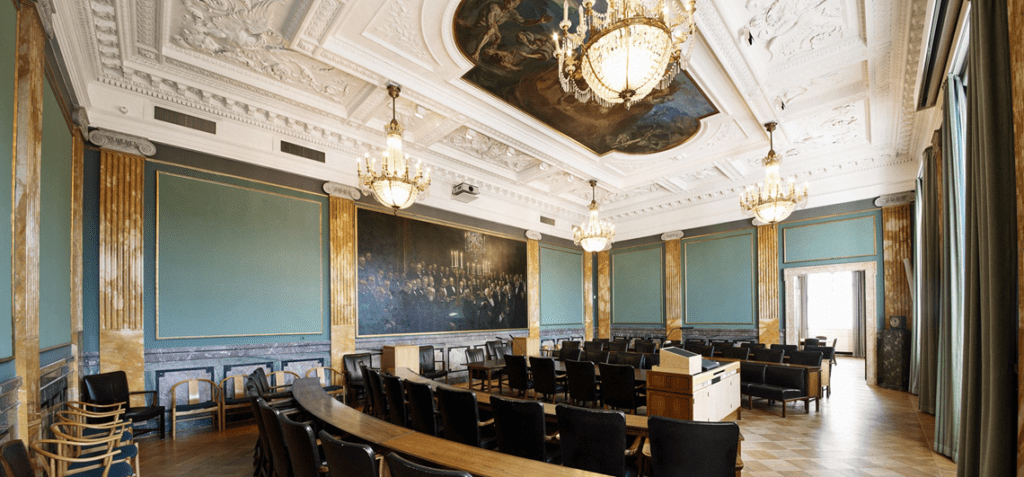
The meeting will take place at the Royal Academy of Sciences in Copenhagen and is also open for online participation.

At the meeting, the Board of Technology as one of the partners in RETHINK will present the project findings and several recommendations on how to improve science communication. Additionally, Cissi Askwall from Vetenskap & Allmänhet (Public & Science) will be presenting initiatives in Sweden to systematically improve science communication there. The presentations are followed by a discussion on whether we need to rethink Danish science communication.

During the debate, we will include experiences and suggestions from the participants, so that everyone may be heard. Please attend and take part in finding solutions!

SIGN UP FOR THE MEETING:

The meeting will be in Danish. Find the link to the registration form in the Danish article HERE.

The meeting is open for everyone, and participation is free. Only a limited number of physical seats are offered for the event. Should you be prevented from participating, please cancel your reservation no later than 1 February so that your seat may go to someone else. Seats are reserved on a first-come, first-served basis. The debate will be held in accordance with current Covid-19 recommendations.

Registration deadline: 31 January.

PROGRAM:


3:00 Welcome


  • Moderator: Peter Hyldgård, Formidlingsakademiet (The Academy of Communication) under the Royal Academy of Sciences

3:20 Findings of the RETHINK project


  • Frederik Langkjær, project manager at RETHINK, the Danish Board of Technology

3:50 Science Barometer 2021, Sweden


  • Cissi Askwall, Secretary General, Vetenskap & Allmänhet (Public & Science)

4:10 Break


4:30 Panel debate with


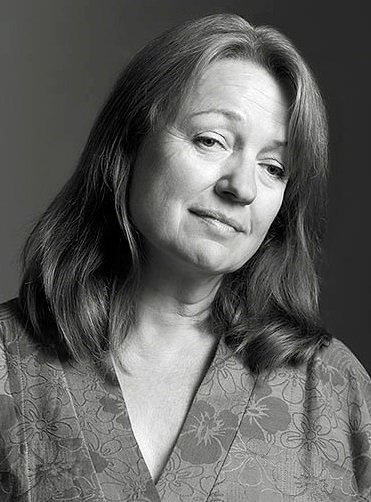
  • Lone Simonsen, professor at Roskilde University, winner of the Science Communication Prize 2021
  • Rasmus Larsen, Vice-president at DTU
  • Morten Elsøe, communicator with a focus on our relationship to food & body, misinformation, and critical thinking
  • Steffen Lüders, Senior Vice President, Communications, Novo Nordisk Foundation

5:30 Reception


6:00 Event concludes
The Carlsberg Foundation research prizes 2022

The Carlsberg Foundation research prizes 2022

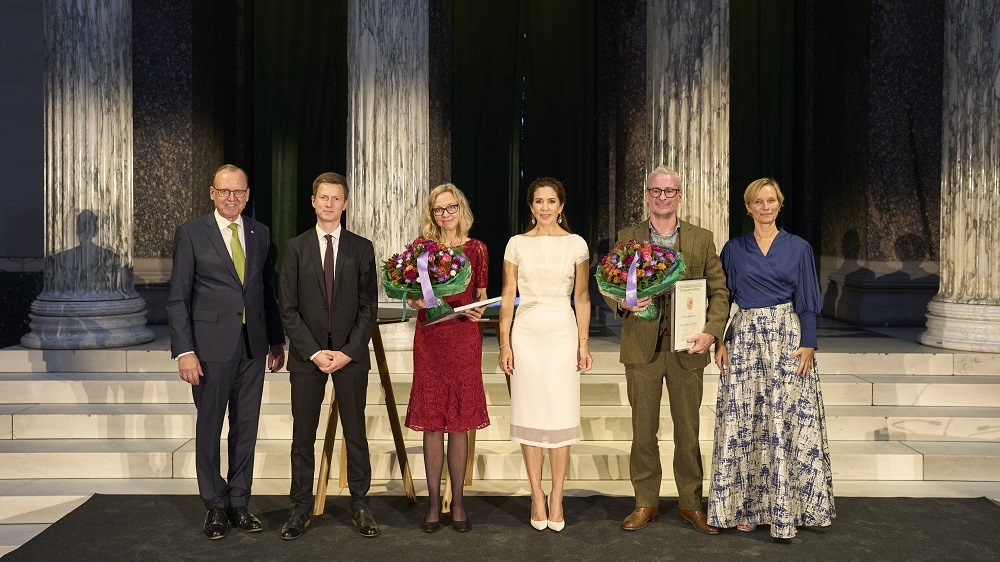
From the prize-giving ceremony last year. Photo: The Carlsberg Foundation
Call for nominations of recipients for the Carlsberg Foundation Research Prizes

On the occasion of the 200th birthday of Brewer J.C. Jacobsen in 2011, the Carlsberg Foundation established two Research Prizes – one is presented to a scientist within the natural sciences, and one is awarded to a scientist within the humanities or social sciences. The prizes are awarded once a year, and each prize is worth 1 million Danish Kroner. The prize is divided between further research work (750.000,-) and a personal award (250.000,-).

The two prizes are awarded to active scientists who have contributed considerably to basic research and are widely recognized in the scientific environment.

The prizes will be presented by Her Royal Highness Crown Princess Mary at a ceremony at the Ny Carlsberg Glyptotek in Copenhagen on Wednesday 31 August, 2022.

Nominators and nominees

  • Candidates must be active scientists of any nationality employed in a Danish research institution or Danish scientists living and working abroad
  • Research institutions in Denmark and scholars in Denmark and abroad may nominate a candidate
  • Candidates who have been nominated on earlier occasions may be nominated again
  • Self-nominations are not accepted
  • Neither nominator nor nominee needs to be a member of the Royal Danish Academy or to be a Carlsberg Foundation grant holder

Award criteria 

The outstanding candidates have/must be:

  • Demonstrated outstanding impact and sustained performance in research over many years
  • Transformed, changed, moved, or challenged disciplines
  • Contributed to science by rethinking or changing data, theories and/or methods
  • A role model for younger scholars

The recipients of the prizes are selected by an international prize committee set up by the Royal Danish Academy of Sciences and Letters and the Carlsberg Foundation.

Please fill in the form (CLICK HERE) and attach one full PDF with 1) a motivation for the nomination (3 pages maximum) and 2) a CV, preferably including a list of publications, in the order mentioned. The nomination must be in English.

All nominations must have been submitted by Thursday 10 March 2022 at 12.00 noon.

For further information, please contact Birgit Olsen on bo@videnskabernesselskab.dk.

The Royal Academy of Sciences and Letters welcomes new members

The Royal Academy of Sciences and Letters welcomes new members

The new members of the Royal Academy’s Humanities and Social Sciences class have now been announced.

In December, the Royal Academy had the pleasure of welcoming nine new members. The following researchers have been elected:

Professor Pia Quist, University of Copenhagen, Department of Nordic Studies and Linguistics

Professor Morten Bennedsen, INSEAD and University of Copenhagen, Department of Economics

Professor Dorthe Berntsen, Aarhus University

Professor Michael Fjeldsøe, University of Copenhagen, Department of Arts and Cultural Studies

Professor Morten Axel Pedersen, University of Copenhagen

Professor Ning de Coninck-Smith, Danish School of Education (DPU), Aarhus University

Professor John Earl Joseph, Edinburgh University

Professor Makoto Murai, Waseda University, Tokyo: Historical Institute for European Civilization (HIEC)

Professor Morten H. Christiansen, the William R. Kenan, Jr., Professor of Psychology, Dept. of Psychology, Cornell University, Ithaca, New York

All elected members for 2021 belong to the Academy’s Humanities and Social Sciences class. In 2022, members for the Academy’s Science class will be elected.

Interdisciplinary meeting place for young researchers celebrates 10th anniversary

Interdisciplinary meeting place for young researchers celebrates 10th anniversary

Photo by: Lars Svankjær / Royal Academy
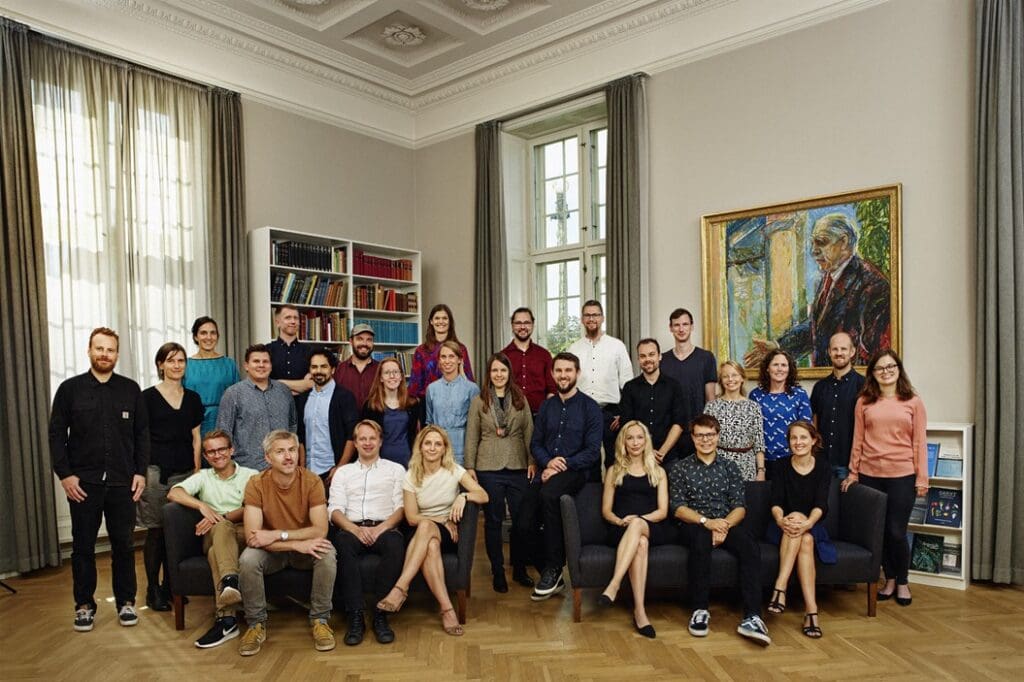
This year, The Young Academy celebrates its 10th anniversary. On December 1st, the occasion was marked by a celebration at the Carlsberg Academy.

In 2011, The Royal Academy established The Young Academy (DUA). The Young Academy is an independent unit under the Royal Academy of Sciences and was born out of a wish to create a cross-disciplinary meeting place for young, talented researchers. Here, there would be room for engagement in research policy topics, interdisciplinary collaboration, and science dissemination to a broad audience.

– The Young Academy is important as a forum for developing cross-disciplinary collaboration, giving added focus to general research dissemination and not least as an important voice, speaking in particular for young researchers and their working conditions. I am convinced, that DUA will have a leading role to play for many years into the future, says Karen Vallgårda, chairperson of The Young Academy.

And the future is a good place to look to. After a full 10 years of existence, DUA is as active and engaged as ever, giving reason to believe that The Young Academy will continue for at least as many years as it has existed already.

Just as it was intended from the beginning, DUA now has 40 members, representing a wide range of scientific disciplines from all the universities in the country:

– The fact that we represent so many different disciplines and come from different universities means that we have a unique insight into the working conditions of researchers in different parts of the country. It also means that we truly can work together across disciplines and take that as our starting point when communicating to the general public. In addition to being fun and educational for us, it also gives us a solid foundation for contributing to the public debate on research policy, Karen Vallgårda explains.

In line with DUA’s work, a panel debate was held at the anniversary celebration on December 1st, focusing on Danish research and research policy over the past 10 years – as well as for the next 10 years. Here, key figures in Danish research and journalism discussed the relationship between basic research and applied research, society at large, the politicians’ views on research and not least the plight of researchers and research in Denmark.

In addition to its current 40 members, DUA has an alumnus of 51 researchers. Naturally, they were also invited to the anniversary celebration at the Carlsberg Academy. As well as the panel debate, they could look forward to celebratory speeches by former and present chairpersons of DUA, presidents of the Royal Academy of Sciences and not least a musical performance by artist, composer and cellist Josefine Opsahl.

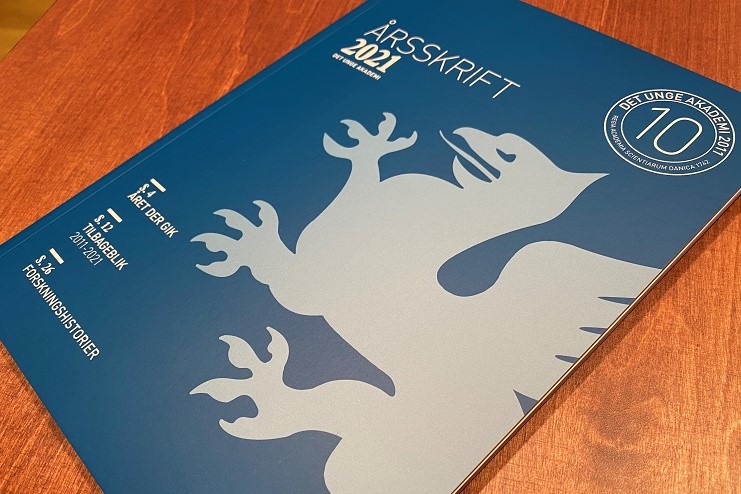
To mark the anniversary, DUA issued a “Festschrift”, which was published at the Carlsberg Academy celebration.

DUA in short

The Young Academy (DUA) was founded in 2011 under the Royal Danish Academy of Sciences and Letters. DUA currently has 40 sitting members and counts 51 alumni. After election, membership of DUA lasts 5 years. The chairperson of DUA is Karen Vallgårda, associate professor at the Saxo Institute, Copenhagen University. The deputy chairperson is associate professor Niels Martin Møller at the Department of Mathematical Sciences, Copenhagen University. Read more about DUA here. 

Christmas project is “healthy exercise” in communication

Christmas project is “healthy exercise” in communication

Image from the video series, produced by Boomshanka Productions for the Royal Academy, 2021
In December, the Royal Academy of Sciences published 8 short films explaining the scientific content of this year’s televised Christmas calendar series on TV2. In them, Academy members gave short research-based answers to why our world looks the way it does.

By Rikke Reinholdt Petersen

This December, the Danish television station TV2 broadcast the Christmas calendar Kometernes jul (The Comets’ Christmas) which is largely about science. That is no coincidence, but rather connected to the recently launched “Year of Science 2022” initiative – a yearlong dissemination project aimed at bringing science to the public through a series of activities with science at a suitable level.

The best of several scientific realms

The 8 short films are the Royal Academy’s first contribution to the dissemination activities connected with the Year of Science 2022. The films address the science topics that are touched upon in various episodes of the TV2 Christmas calendar, Kometernes jul.

But unlike the televised Christmas calendar, which mainly looks at topics about space and the universe through the eyes of the natural sciences, the Royal Academy’s 8 videos take a different path – actually, two paths. The Royal Academy has in fact taken the best from all branches of science – the humanities, the natural sciences and the social sciences – asking members with widely different professional backgrounds to contribute.

The result is an interdisciplinary coverage of the topics in the videos, where everything from anthropology and brain surgery to art history and quantum physics is at play. In this way, each scientific field enriches and illuminates the explanations of the others. One example is a video in which literary scientist Lene Østermark-Johansen and brain researcher Gitte Moos Knudsen together give the viewer an insight into literary and cultural history’s portrayal of the phenomenon of infatuation – as well as the neurological explanation underlying the emotion.

From the abstract to something tangible

Quantum physicist Peter Lodahl, who also participated in the video series, says that he was very intent on ensuring that his contribution should go beyond the abstraction level of his research field:

– “Understanding quantum physics requires a certain amount of abstraction to get used to the strange properties exhibited by microscopic objects such as atoms and photons,” he says and continues:

– “In communicating, it is important to be aware that a lot of that abstraction is something you take for granted after many years of working in this field. Instead, one should try to illustrate the concepts using concrete pictures,” he explains.

Lene Østermark-Johansen shares Lodahl’s point of view and sees it as a good exercise in science communication in general:

– “I thought it was fun to be a part of this project, and even though my words have been cut thoroughly, the finished product is neat and appealing as popular communication. My original thoughts about the act of falling in love, running from Plato over Dante and Petrarca to Shakespeare were, of course, boiled down to an absolute minimum; I think I probably need to get used to such a reduced version of myself, but it is a healthy exercise,” remarks Østermark-Johansen.

Science meets the general public

That wish to communicate clearly and effectively, displayed by the participating members, hits the core intention of the Academy’s video series right on the nose. Optimally, science dissemination should be conducted in a way where no one feels they need a doctorate to understand it – or to feel entertained.

This is in line with the Year of Science 2022 initiative with its aim of reaching other places than those where science is conducted on a daily basis. Science is after all important for all our everyday lives and the world. Therefore, communicating that knowledge so that we may all understand it – and understand the importance of it – is absolutely crucial.

Peter Lodahl agrees: “I am ‘all in’ on the importance of disseminating our research, and that is why I greatly value this kind of initiative [the video project, ed.]. I hope it may play a part in bringing it to public attention,” he concludes.

Click here to see all the Royal Academy videos in the series The Science in Kometernes jul. The videos are in Danish.

Throughout the Year of Science 2022 the Royal Academy will contribute with a number of different projects, which will be announced on the Academy website.

Professor Thomas Sinkjær elected new secretary general at the Royal Academy

Professor Thomas Sinkjær elected new secretary general at the Royal Academy

Photo: Lars Svankjær / The Royal Danish Academy of Sciences and Letters *this press release has been translated from a Danish version published on the 28th of September 2020
The members of the 278 years old academy have elected a remarkable person in Danish science as their new Secretary General. Professor Thomas Sinkjær has occupied great posts in governing boards of foundations and is behind the publishing of more than 200 scientific articles.

In the years to come, Professor Thomas Sinkjær will be seated at the same table as great Danish scientists before him like Hans Christian Ørsted, Japetus Steenstrup and Martin Knudsen. Luckily, he is bringing a great deal of experience to that very same table.

Extensive experience

Throughout the last many years, Thomas Sinkjær has, besides being an active scientist, also occupied remarkable posts in both public and private research foundations. For instance, he has been the Director of the Danish National Research Foundation, the Research Director of the Villum Foundation and the Lundbeck Foundation, and until April 1st this year, he directed the Lundbeck Foundation’s Talent Programme. Furthermore, he is a member of the Danish Council for Research and Innovation Policy, meaning he has a lot of knowledge regarding the Danish research community, both politically, strategically and practically speaking. All this knowledge and experience is something he hopes to put to good use working on the continuous development of the Royal Academy:

– ”There is plenty of work to be done, for example in relation to building trust and confidence between scientists and the Danish Parliament, the managements at universities and licensees, so we can create good conditions for the scientists to work under. The Royal Academy has a special role to play here, as we are one of only a few organizations speaking on behalf of all areas of science. For instance, we need to make sure that there is a clear attitude towards the balance between basic research means and those research means exposed to competition, as well as the attitude towards terms and conditions of employment, legal capacity, securing professional evaluations and collaborations between universities and external partners”.

As a scientist, Thomas Sinkjær is a Professor of neuroscience and technology at the University of Aalborg and has for many years worked in the cross field of natural sciences and health sciences, especially with a focus on how the brain controls motions when walking.

Wishes to keep up the professionalization

During the last couple of years, the Royal Academy has gone through a process of professionalization that has, among other things, resulted in a more pronounced role in the public debate. That process is one that Thomas Sinkjær wishes to continue:

– “The Corona pandemic has once again clearly shown us that all areas of science are essential when it comes to creating a safe and positive future. That is why it is so important that science is moved to the top of the political agenda, as well as it is also important that the Royal Academy can contribute to securing favourable terms when creating valid scientific results in Denmark – and that such results are put to use by decision-makers, in industrial connections as well as among the population in general. And because of that, the Royal Academy must strengthen its research communication even more, and preferably in collaborations with foundations and others sharing the same agenda.”

As Secretary General of the Royal Academy Thomas Sinkjær will oversee the carrying through of decisions made by the Academy’s members, and he will also be the person responsible for the Academy’s secretariat and budget and accounts. Thomas Sinkjær will take up the post as Secretary General effective immediately.

For further press related information, please contact Head of Communications at the Royal Academy Kristoffer Frøkjær on +45 31146101 or e-mail kf@royalacademy.dk.

About Thomas Sinkjær


1958: Born in Holstebro, Denmark

1983: Master of Engineering, University of Aalborg

1988: PhD, University of Aalborg

1993-: Professor at the University of Aalborg

1993-2006: Leader of the basic research center SMI (“Sanse-Motorisk Interaktion”)

1998: DMSc, University of Copenhagen

2006-2015: Director of the Danish National Research Foundation

2015-2017: Research Director of the Villum Foundation

2018-2021: Research Director and later Programme Leader at the Lundbeck Foundation


Thomas Sinkjær has also received several big research prizes, for instance the Villum Kann Rasmussen Grant and the Steven Hoogendijk Prize.

New initiative prepares scientists for communication and debate

New initiative prepares scientists for communication and debate

Photo: Royal Academy
In the course of the next three years, more than 250 scientists will have the opportunity to participate in “the Academy of Communication” (“Formidlingsakademiet”) when the Royal Danish Academy of Sciences and Letters this autumn presents a large-scale course on communications. The project is funded by the Carlsberg Foundation and the Novo Nordisk Foundation with more than 4 million DKK.

”Now, more so than ever, we need scientists from every scientific field to share their knowledge and to partake in public debates – which makes it paramount that they are equipped with the skills to do it, as well as the interest in doing so” says Prof. Marie Louise Nosch, President of the Royal Danish Academy of Sciences and Letters, when asked about the motivation for creating the Academy of Communication. At this academy, some of the most experienced and well-renowned communicators in the media as well as the scientific landscape of Denmark will provide the participants with excellent communicative tools to help them share their latest research whether they are presenting something to the media, at a lecture or partaking in heated panel discussions.

Generally speaking, science and technology are part of all areas of our modern lives. To navigate our own lives as well as our roles as part of a greater society, we all need valid information from the scientific world. This goes for situations of great immediate interest like the Covid-19 pandemic during which we have been listening to scientists speaking of their latest results on a daily basis, but also for other long-term societal discussions in relation to topics such as health, economy, food products, climate change, digitization and other problems that we have yet to discover but which can be solved by basic research.

With science today being challenged by tendencies like “science denialism” or fake news, it seems clear that solid and creative communication of basic research is even more important now than ever before. And that is where the Academy of Communication finds its relevance.

And the funding of the project likewise:

”I am very excited about the establishing of the Academy of Communication for scientists in Denmark. It is very important to the Carlsberg Foundation to support a science-based development of society. However, such a development requires scientists and experts competently participating in the public debate on the subjects important to us all. And for that reason, I am very pleased that a large number of scientists throughout the next three years will have the opportunity to acquire the necessary skills to contribute with solid and factual knowledge in the public debates and discussions that continuously present themselves in our society,” states Prof. Flemming Besenbacher, Chairman of the Carlsberg Foundation.

His opinion is shared by Steffen Lüders, Senior Vice President of the Novo Nordisk Foundation:

”Excellent researchers are not necessarily good at communicating what their research is all about and why it is interesting to others. We would like to change that, because there are so many interesting and important stories in science that deserve a much bigger audience than what they have now.”

In total, the two foundations have funded the project with more than 4 million DKK which will be used on establishing and developing the Academy.

The Academy of Communication will generate a thoroughly tested model for research communication

Participating in the classes of the Academy of Communication is free, and participation from all areas of research is possible. The Academy will be composed of a class with physical attendance for 15 participants, which requires an application beforehand, as well as an online class for about 80 participants which only requires registration. A podcast touching on the key points of the classes at the Academy for everyone who is interested in learning more about research communication will be published later on.

After three years of running the Academy of Communication, we hope to have gained sufficient knowledge to create a model of teaching research communication that may be used by other institutions and that, furthermore, can be published in book form. The Academy officially commences in the autumn of 2021, and the first class of scientists ready to do media appearances, lectures and participate in debates will graduate in June 2022. Should you have any questions, or would you like to participate, you are welcome to contact us on Formidlingsakademiet@videnskabernesselskab.dk.

For all press related information, please contact Head of Communications at the Royal Danish Academy of Sciences and Letters, Kristoffer Frøkjær on telephone number +45 31146101 or e-mail kf@royalacademy.dk.

Carlsberg Foundation research prizes 2021

Call for nominations

Carlsberg Foundation research prizes 2021

On the occasion of the 200th birthday of Brewer J.C. Jacobsen in 2011, the Carlsberg Foundation established two Research Prizes – one is presented to a scientist within the natural sciences, and one is awarded to a scientist within the humanities or social sciences respectively. The prizes are awarded once a year, and each prize is worth 1 million Danish Kroner. The 1 million Danish Kroner per prize is to be divided between further research work (750.000,-) and a personal award (250.000,-).

The two prizes are awarded to active scientists of any nationality employed in a Danish research institution or Danish scientists living abroad who have contributed considerably to basic research and are widely recognized in the scientific environment. The prizes are thought to incite further research.

The prizes will be presented by Her Royal Highness Crown Princess Mary at a ceremony at the Ny Carlsberg Glyptotek in Copenhagen on Sunday September 5th, 2021.

Nominators and nominees

  • Candidates must be active scientists of any nationality employed in a Danish research institution or Danish scientists living and working abroad
  • Self-nominations are not accepted
  • Research institutions in Denmark and scholars in Denmark and abroad may nominate a candidate
  • Candidates must be active researchers, meaning that they are not yet retired from their employment/occupation at the time of nomination
  • Candidates that have been nominated on earlier occasions may be nominated again
  • Neither nominator nor nominee needs to be a member of the Royal Danish AcademyNeither nominator nor nominee needs to be a holder of a grant from the Carlsberg Foundation

Award criteria

The outstanding candidates have/must be:

  • Demonstrated outstanding impact and performance in research
  • Transformed, changed, moved, or challenged disciplines
  • Contributed to science by rethinking or changing data, theories and/or methods
  • A role model for younger scholars

The recipients of the prizes are selected by an international prize committee set up by the Royal Danish Academy of Sciences and Letters and the Carlsberg Foundation.

Please fill in the form below (or click link here) and attach one full PDF with 1) a motivation for the nomination (3 pages maximum) and 2) a CV, preferably including a list of publications, in the order mentioned.

All nominations must be in English and must be submitted on Monday May 10th, 2021 at 12.00 a.m. 

For further information, please contact Mette Miller Danielsen on mda@royalacademy.dk.

300.000 pages of science right at hand!

300.000 pages of science at your fingertips!

Photo: Royal Academy
What do mammoths, meteors and the principals of moral philosophy have in common? They can easily be looked up on our brand-new platform, which is a public-access, free-of-charge tool that allows you to browse through all the scientific books and articles the Royal Academy has published since 1745.

Ever since establishing the Royal Danish Academy of Sciences and Letters during the Age of Enlightenment in Denmark, makingscience and scientific results accessible to everyone has been a fixed part of the Royal Academy’s agenda. As a result, we are now launching a brand new online public access platform that allows you to browse through all books that have been published by the Royal Academy since the establishing of the Academy’s publication house in 1745.

Whether you are a scientist, a student, or simply just curious about science and its long history, the platform gives you free unlimited access to just about 6.500 research papers, counting no less than 300.000 pages of scientific material, covering a wide field of scientific and historical topics.

A handy tool and a candy store in one

To create the most flexible and user-friendly tool, we have put a lot of time and work into developing the publication platform. A team of experts have worked hard to create a custom-made product containing picture scans of a high image quality, search functions matching the needs of the user as well as downloading functions. A high standard of optical character recognition (OCR) has also been a focal point in developing the platform. The OCR has been successful in most cases, although we are still waiting for the technical advantages that allow the OCR to work well on texts written in gothic letters.

One of the experts of the team behind the creation of the platform is former editor at the Royal Academy, DPhil Marita Akhøj Nielsen, who possesses an extensive knowledge when it comes to the bibliography of the Royal Academy:

“It is wonderful to be able to open the treasure chest of scientific results that is the published material of the Royal Danish Academy of Sciences and Letters and share it with everyone. There is so much to read – and so many fascinating pictures to look at – that it is positively overwhelming”, she says.

New titles all the time

Naturally, we intend to keep the platform updated with the newest scientific publications from the Royal Academy and will therefore continuously upload new publications only a year after publishing the printed version. In the meantime, the books will of course be available for purchasing on the Royal Academy’s web shop.

So, whether you are looking to find something about different species of octopuses, Punic idols, records of King Canute’s coin collection or the astronomical observations of Venus’ passage by the Sun in 1769 – or any other subject, really – you have come to the right place.

To access the publication platform, click here.

Should you have any questions, please write an e-mail to the secretariat of the Royal Academy on kdvs@royalacademy.dk.

The Royal Danish Academy of Sciences and Letters elects new editor

The Royal Danish Academy of Sciences and Letters elects new editor

Portrait photo of Marianne Pade: Huset Mydtskov
After working for several years in Italy as the director of The Danish Academy in Rome, it is now time for Marianne Pade to return to Denmark where she will take on the job as editor at the Royal Danish Academy of Sciences and Letters. Marita Akhøj Nielsen, who has acted as the editor at the Royal Academy throughout the last 12 years, is very pleased to pass on her seat at the editor’s desk to Pade and predicts a bright future for the publishing department of the Royal Academy with Marianne Pade leading the way.


– I have always been very interested in contributing to creating better conditions for science, which includes the dissemination of scientific results on all levels. Therefore, I naturally thought that it was a once in a lifetime opportunity to get to work within the publishing department of the Royal Academy with the staff and financial resources that come with the job, a most happy Marianne Pade says in an interview with the Royal Academy.

– Throughout the years, I have admired the many initiatives brought to the table by the praesidium – initiatives that have influenced science in Denmark. I am looking forward to taking part in and continuing that work as a new member of the praesidium.

A perfect match for the job

One of the reasons as to why Marianne Pade’s candidacy was approved by the fellow members of the Royal Academy are her many years of editorial work and management. Besides her former position as the director of the Danish Academy in Rome in the years from 2011 to 2019, in which Marianne Pade oversaw the publications of the Academy, she has also been the chairman of Forum for Renaissance Studies and co-founder of the electronic journal Nordic Journal of Renaissance Studies, and she is editor-in-chief of the bio-bibliographic database Repertorium Pomponianum. Furthermore, Pade, who has been a member of the Royal Academy since 2011, is also a member of several scientific and editorial committees for scientific journals and series in Denmark as well as other countries. She is head of the Semper Ardens project ”Cultural Encounter as a Precondition for European Identity” that deals with Latin literature of the modern period and is a Doctor of Philosophy and professor of classical philology.

12 years and two election periods have passed

While Marianne Pade starts to settle in at the editor’s office at the Royal Academy, Marita Akhøj Nielsen is, naturally, a little sad to see her time as editor come to an end. She is, however, at the same time very pleased and proud of everything she has achieved in her 12 years of working as the editor, as she is now preparing to welcome Marianne Pade as her successor.

– 12 years is a long time, and it has been incredibly exciting to be the editor of the Royal Academy for all this time, although there has also been a lot of time-consuming work. I will miss being in touch with members from scientific fields very different to my own, working together with the graphic designers, typographers and printers as well as working closely together with the secretariat of the Academy. It sure will be a strange feeling not to be part of ”the house” anymore, she explains.

When Marita Akhøj Nielsen took over the job as editor of the Royal Academy back in 2008, she set up two goals: First of all, she wanted all books published by the Royal Academy subjected to thorough peer review, and second of all, she was determined to have every single book ever published by the Academy since the year 1745 digitized and published online. And, with the launching of the Academy’s first ever online publication platform in the beginning of 2021, she has officially met the goals she set up for herself in the beginning. That of course makes it a great deal easier for her to happily hand over the job to Marianne whom she also has a lot of confidence in, personally as well as academically.

– The publications are an essential part of the activities and identity of the Royal Academy, and the Academy provides a unique opportunity to publish books and articles on basic research that are a 100 % initiated by the scientists themselves, she explains and continues:

– Which is why it is paramount that the editor of the Royal Academy is an established scientist, experienced publisher and at the same time also a dedicated worker. Marianne Pade lives up to all these criteria, she says, and concludes:

– It is my great hope that Marianne will be just as happy with the job as I have been, and with the assistance of the highly qualified, pleasant, and efficient employees that handle all the secretariat’s work related to publishing, I would say that the future indeed is looking very bright.

The election period of Marianne Pade began on the 24th of September and will last for the 6 forthcoming years.

For more information, please contact Academic Employee Rikke Reinholdt Petersen on rp@royalacademy.dk or telephone number +45 33 43 53 10. For information regarding press, please contact Head of Communications Kristoffer Frøkjær on kf@royalacademy.dk or telephone number +45 31 14 61 01.

About Marianne Pade


• Born on the 8th of March, 1957 • Graduate in classical philology from the University of Copenhagen • PhD in 1989 • employee at the Thesaurus Linguae Latinae in München 1989-91 • Humboldt-Fellow at Institut für Geistesgeschichte des Humanismus, München 1994-96 • Head of the two-year science network “Renæssancen: modernitetens oprindelse” (English: ”The Renaissance: The origin of modernity”), granted by SHF, from 1997-99 • Coordinator of the Scandinavian network about “Portræt og selviscenesættelse i renæssancen” (English: ”Portrait and self-presentation in the Renaissance”), granted by NOS-H, from 1999-2001 • Supply associate professor in classical philology, University of Aarhus from 2001 • Appointed Research Council professor in 2004 • Doctor of Philosophy in 2007 • Professor of Philology from 2009 • Member of the Royal Academy of Sciences and Letters in 2011 • Director of the Danish Academy in Rome from 2011-2019 • Head of the Semper Ardens project ”Cultural Encounter as a Precondition for European Identity”, granted by the Carlsberg Foundation from 2015-2021.