Forward-looking research in global health and inequality wins Silver Medal

Royal Danish Academy of Sciences and Letters Silver Medal 2022

Forward-looking research in global health and inequality wins Silver Medal

Photo: Vladimir Manov
José Manuel Aburto’s research explores the long-term impact of inequality on the health and mortality of the global population, which the COVID-19 pandemic has also brought to the fore. His work has earned him the Silver Medal of the Royal Danish Academy of Science and Letters.

– “The COVID-19 pandemic has had drastic consequences for health and mortality globally. While Denmark is an exception, large parts of the world continue to suffer from the impacts of crises”, explains Aburto.

Aburto is assistant professor at the Interdisciplinary Centre on Population Dynamics (CPop) of the University of Southern Denmark, where he conducts demographic research, also investigating health and mortality disparities in the global population – a highly topical field in recent years.

In his research, Aburto has explored the impact of structural shocks, such as increased violence – and most recently the COVID-19 pandemic – on the health and mortality of the global population, providing us with valuable and crucial insights into the long-term global consequences of these types of scenarios. In recognition of his work, he has been awarded the Silver Medal of the Royal Danish Academy of Sciences and Letters.

– “I am deeply honoured to receive the Silver Medal from the Royal Danish Academy of Sciences and Letters”, says a delighted Aburto about his prize, which will be awarded at a members’ meeting at the Royal Academy on 27 October 2022.

– “A significant part of my professional development and my research has happened here in this wonderful country, and I’m extremely grateful to my supervisors, colleagues and family, who have supported me in all my projects. So this recognition very much also goes to them”.

Dissemination and involvement

The Silver Medal of the Royal Danish Academy of Sciences and Letters carries a monetary award of DKK 100,000, which Aburto is considering putting towards the continued development of demographic models that help us to understand the long-term consequences of the COVID-19 pandemic in low- and medium-income countries. He also plans to spend some of the money on building up a collaborative network between younger researchers from Africa and Latin America.

The adjudication committee that selected Aburto for the Silver Medal emphasised, for example the wide reach of his work, pointing out in their recommendation that his research has reached important audiences beyond the research world, including political decision-makers and the general public.

Cross-disciplinary approach to a global challenge

One feature of Aburto’s research is its obvious cross-disciplinary nature, which the adjudication committee sees, for example in its use of methods from e.g. computer science and statistics. Aburto describes this cross-disciplinary approach and treatment of the data as absolutely essential to his work:

– “We work together with epidemiologists, biologists, sociologists and others from the social sciences. I have been able to approach issues from very different angles throughout my career, thanks to the cross-disciplinary nature of my field […] Given the many conflicts globally, it goes without saying that this subject deserves even greater attention from a cross-disciplinary perspective”, he concludes.

The Silver Medal of the Royal Danish Academy of Sciences and Letters

The Silver Medal of the Royal Danish Academy of Sciences and Letters is awarded once a year to a Danish researcher below 40 years of age for a particularly significant thesis or overall scientific project published in the last five years. The prize is awarded alternately to a researcher within the humanities or within the natural sciences and the winner of the Silver Medal receives a grant of DKK 100,000 to be spent on their research. Read more about the Silver Medal and previous recipients.

The members of the adjudication committee awarding the 2022 Silver Medal of the Royal Danish Academy of Sciences and Letters were Morten Bennedsen, Morten Rievers Heiberg, Knud Haakonssen, Karen Fog Olwig and Karen Skovgaard-Petersen.

For press material on the 2022 Silver Medal of the Royal Danish Academy of Sciences and Letters, please contact communications consultant Rikke Reinholdt Petersen at rp@royalacademy.dk or tel.: +45 33 43 53 10

About José Manuel Aburto


  • Born 21 October 1987
  • BSc in actuarial science and mathematics from Universidad Autónoma de Guadalajara, Mexico
  • MA in demography from El Colegio de México
  • Studies at the European Doctoral School in Demography and work at La Sapienza, Rome
  • PhD in demography from the University of Southern Denmark and Max Planck Institute for Demographic Research in 2020
  • Since 2020 assistant professor at the Interdisciplinary Centre on Population Dynamics, University of Southern Denmark, and fellow of Newton International, Department of Sociology, Leverhulme Centre for Demographic Science and Nuffield College, University of Oxford
  • Winner of multiple international research awards, notably the Newton Fellowship from the British Academy and a Marie-Skłodowska-Curie Fellowship
  • His latest prize is the European Demographer Award 2021 from the Förderfonds Wissenschaft in Berlin and the secretariat of the European research network Population Europe

Ukrainian scholars’ days at the Royal Academy offered insight and networking

Ukrainian scholars’ days at the Royal Academy offered insight and networking

Twenty-five Ukrainian scientists residing in Denmark outlined the situation for research in Ukraine to the Ukrainian ambassador and various Danish foundations and put forward their ideas for improvements.

On Thursday 6 October 2022 the rare sound of children’s voices was to be heard at the Royal Academy when 25 Ukrainian scientists, predominantly women, paid a visit with their families. Many of them have moved here with their children from a country whose research organisations, not to mention society as a whole, are badly affected by the war, with the bombing of one of the world’s largest seed banks and of a newly built neutron facility, as well as the destruction and wide-scale plundering of IT and other vital research equipment.

The 25 scientists from Ukraine have found refuge in Danish research environments – at least for the time being – but are in a difficult situation personally and regarding their research, particularly because they lack a network.

– “My goal with this event is to make the Royal Academy a platform for Ukrainian scientists to come together”, explains Academy President Marie Louise Nosch.

– “Hopefully it can become a haven and our members a resource for them. We have set up a mentor scheme that puts members of the Danish Young Academy (DUA) and members of the Royal Academy in touch with Ukrainian scientists and introduces them to new networks to ensure that the Ukrainians have a much larger professional network when they leave us”.

Ukrainian Scholars’ Days was a two-day event that provided a chance to network, the opportunity to participate in  a boat trip round the Copenhagen canals and to have Danish open sandwiches, in addition to a visit by Danish foundations and the Ukrainian ambassador. At the opening of the event the Ukrainian scientists immediately expressed their enormous appreciation:

– “In these difficult times it’s wonderful to be welcomed so warmly by university presidents, professors and other colleagues and equally fantastic to receive an invitation such as this to the Royal Academy”.

10 points on supporting Ukrainian research

The timing of this event was no coincidence. In early summer the Royal Academy, together with international collaborators such as the European Federation of Academies of Sciences and Humanities (ALLEA) and other science academies, summarised in ten points ways in which the Ukrainian research community can be helped:

– “Following on from the ten points that we agreed upon with international partners a few months ago, we have now taken the next step by holding this event. The Royal Academy chose to invite DUA to be a partner because many of the scientists coming here are young”, explains Nosch, with Kristoffer Kropp, chair of DUA adding:

– “DUA hopes that this event will help Ukrainian scientists to look beyond their daily lives and give them opportunities to find their place in Denmark. DUA is providing professional input so that we do not spend all our time talking about problems but instead about our passion, namely research. Even though the world is burning we need to keep focusing on research and on exciting and important issues. My hope is that we can help to build bridges between Ukrainian scientists and DUA’s members”.

Ukrainian challenges and Danish foundations

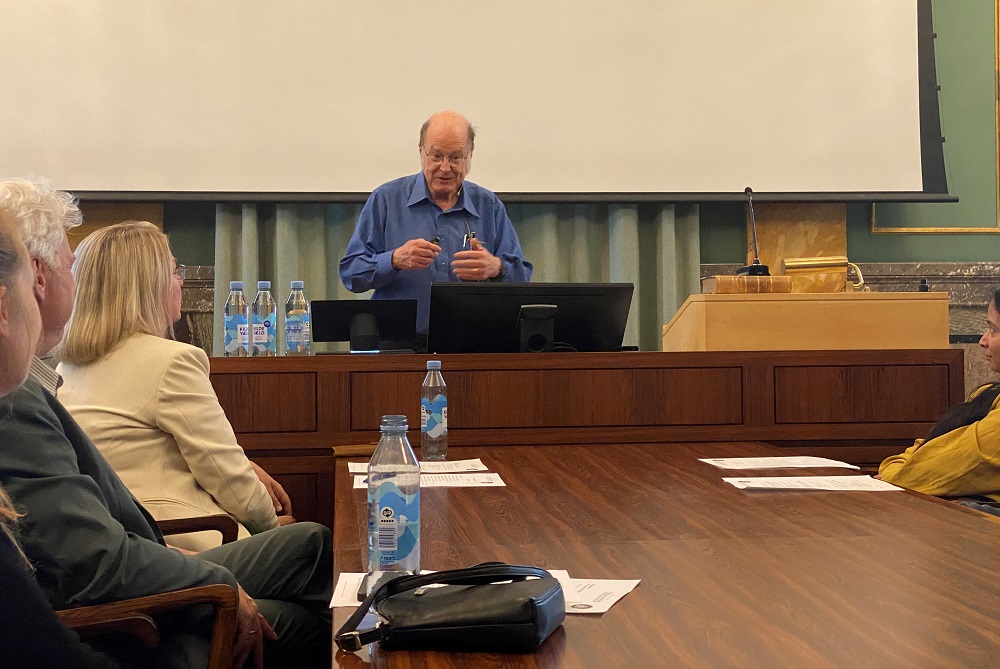
This event was about more than just networking, it also embraced the exchange knowledge and ideas. Senior researcher Oksana Piven, who is affiliated with the Institute of Molecular Biology and Genetics of the National Academy of Sciences of Ukraine, outlined the situation and future scenarios to the Danish and Ukrainian scientists and foundation members in a speech in the Old Meeting Hall:

– “The research community in Ukraine is beset by enormous problems, right now because of the war of course, but before the war the situation was not good either. Many researchers in the country look to go abroad because of lack of opportunity and money, so one of the main challenges is the brain drain – also when it comes to rebuilding research after the war, she explains, and displays a slide showing that the Ukrainian state spends 0.17% of its gross national product (GNP) on research and that the lion’s share of the financial resources comes from funding”.

In Denmark the state spends at least ten times more of its GNP on research.

Among the audience in the hall were Lene Oddershede, Senior Vice President for Natural & Technical Sciences at Novo Nordisk Foundation; Majken Schultz, Chair of the Board of Directors of the Carlsberg Foundation; Thomas Bjørnholm, Director of VILLUM FONDEN’s support programmes for research in the technical and natural sciences; and Jan Egebjerg, Senior Vice President for Grants & Prizes and Director of Science at the Lundbeck Foundation. All of them listened attentively – also to the next speaker.

Sophia Opatska is Vice Rector of Strategic Development at Ukrainian Catholic University in Lviv, Ukraine, but she is currently affiliated with Aarhus University. In her speech she mentioned three specific areas where the foundations can help.

– “Many of us Ukrainian scientists present here today obviously feel that our own research fields are the most important. I have thought further and would say that our agriculture, the issue of the brain drain, and the problem of meeting overhead costs are among the biggest challenges that a good recovery plan will need to address after the war”, she explains, turning to members of the audience from the foundations, who subsequently asked questions and were given further details.

Visit by the ambassador

The event included a visit by the Ukrainian ambassador, Mykhailo Vydoinyk, who attended the presentations and discussions and was eagerly awaited by many of the scientists.

– “The fact that the Ukrainian ambassador joined us today is perhaps a sign of the Ukrainian government’s support. It’s time to support science and education, also in a post-war recovery plan”, says Levgeniia Lukianchenko, a visiting researcher at the University of Copenhagen.

It soon became clear in the discussion with the ambassador that the researchers felt that science was given too little priority in Ukrainian society, and they offered advice to both him and each other, including this suggestion:

– “Would it be possible for you to make a list of the scientific fields that are currently active in Ukraine? That would help us to gain a much better picture of the situation while we are unable to live in the country”.

Another suggestion, which was backed by the ambassador, was about burying the Soviet era.

– “If we are to make changes, also after the war, we should write to the government”, suggested one of the scientists in the audience, who went on to comment that doing so during the Soviet era would have been pointless but that the times had changed, and it was important to exert influence wherever possible.

The shared message to the Ukrainian ambassador was clear: the Ukrainian state should realise that research is necessary to create a good future for Ukraine.

Accompanied by a round of applause, and perhaps with a note of greater optimism for the future, President Nosch rounded off the event by expressing her hope that the scientists present would keep in contact and by urging them to use the occasion to create a virtual research centre enabling mutual help across the various research areas, not just while the Ukrainian researchers are living in Denmark, but also when the war is over.

Member of Royal Academy receives prestigious award for his quantum research

Member of Royal Academy receives prestigious award for his quantum research

The Breakthrough Prize is an American award conferred every year to prominent researchers in life science, fundamental physics and mathematics. Among the recipients this year is physicist Charles H. Bennett.

By Kristoffer Frøkjær

For many years quantum computers have been touted as today’s solution for creating more processing power in computers and for increasing encryption security.

Now Charles H. Bennett, physicist and professor at IBM Thomas J. Watson Research Center, and three other physicists who have combined mathematics, computer science and physics to make game-changing discoveries within quantum information have been awarded the Breakthrough Prize, sharing the honour of this distinction and a sum of USD 3 million.

As many of our privately used solutions become digitalised, finding ways to protect our data and privacy against hackers has become increasingly important. This is where quantum cryptography plays a key role in safeguarding communication in the future.

Bennett’s contribution to the development of quantum information consists in devising the BB84 protocol in collaboration with physicist Gilles Brassard. Though may sound like something fictional from a James Bond film, it actually describes a practical way of sending messages between two users without them sharing secret information in advance, making the process very safe.

Bennett was later involved in launching the entire research field of quantum information processing and thus, together with others, paved the way for the quantum computers we will need in the future.

Besides Brassard the other recipients of the Breakthrough Prize in fundamental physics are David Deutsch and Peter Shor.

Annual research policy meeting: successful dissemination of research depends on trust

Annual research policy meeting: successful dissemination of research depends on trust

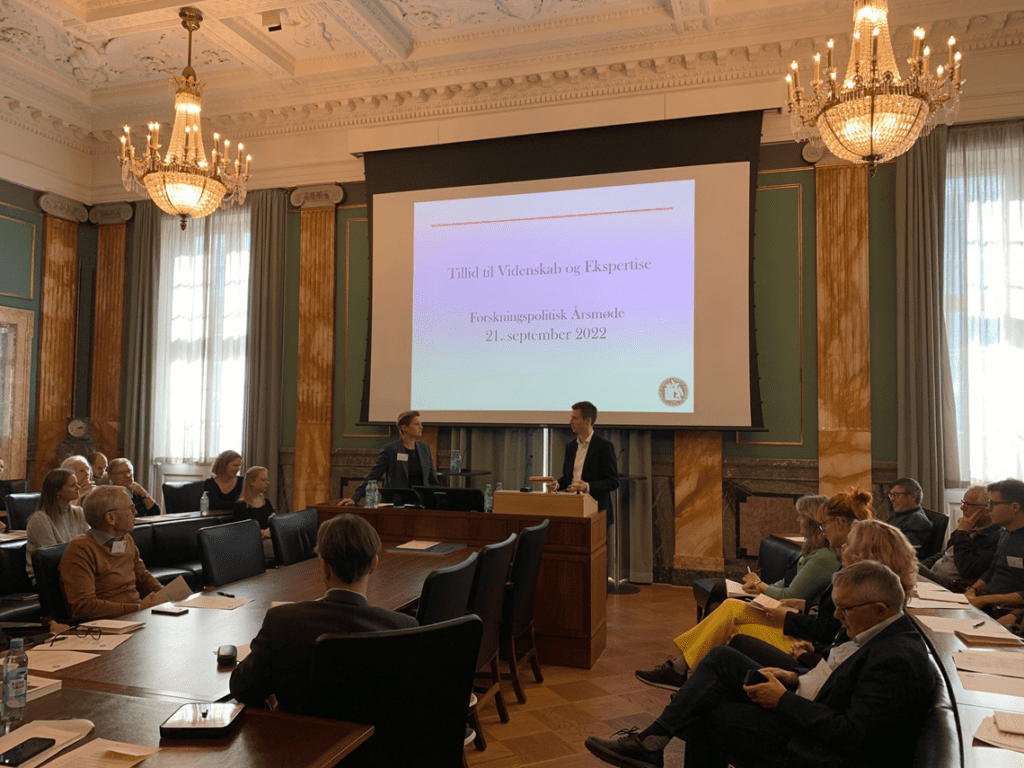
On Wednesday 21 September 2022 the Royal Academy held its traditional annual Research Policy Meeting, which focused on trust in research and expertise and was attended by Jesper Petersen, Minister of Higher Education and Science, with panel debates involving stakeholders from the research community, research-disseminating media and the civil service. The meeting addressed and critically examined the conditions for dissemination of research and public sector consulting.

By Majka Holm, Jonas Krog Lind and Rikke Reinholdt Petersen

At the annual Research Policy Meeting of the Royal Academy the message from the opening speech by the Minister of Higher Education and Science, Jesper Petersen, was clear and unequivocal: the dissemination of research findings – from all fields of research – is essential to society. Consider, for example, the key role assumed by science during the Corona crisis.

Yet, if the research findings from Danish research institutions are to be of any relevance to society, dissemination needs to be effective. And even when typically data-laden, complex research material is communicated in an interesting and lively way, one particular component remains vital to ensure that society and decision-makers sit up and listen: trust.

So how do we build up trust in the research disseminated?

– “To begin with, society has to have confidence in us that we [researchers] work responsibly. We must improve the way we communicate how the science community works, so that its particular value for society is clear”, explains Professor Ole Wæver, chair of the Committee on Research Policy at the Royal Academy.

However, as emphasised by Lone Koefoed, associate professor at Aarhus University, insight into and transparency around the processes by which scientists arrive at their findings and conclusions is not the only important factor. Openness and honesty when scientists do not obtain results, when findings are inconclusive, is equally important.

So does this mean that we are on the right path if we provide insight into processes and methods and also take into account that research does not necessarily always provide answers when we disseminate research findings? According to panel member Jonas Rathje, chief editor of the Danish edition of Science Illustrated, we need to keep in mind that the public at large are generally more interested in results than process and that, likewise, news criteria do not attach particular weight to process and method.

The second panel debate at the meeting considered the issue of public sector consulting. Universities and other research institutions are a constant source of expert advice for the state on various matters; this is necessary to ensure that regulations and laws in a given area are complied with and to create new policies. Furthermore it ensures research and preparedness within specific areas and in a broad sense underpins the work of the public service. There was general agreement that this research-based policy support is absolutely crucial and that it will gain in importance as the challenges become more complex, requiring research-based knowledge and coordination between public service entities. The climate crisis is a good example of this, as is the COVID-19 pandemic.

Here, trust and mutual understanding also play a key role. Scientists must understand the need public service bodies have for advice, and equally, there should be trust that these institutions do not put scientists under duress to produce results that are more in line with the interests of the political system.

However public sector consulting faces a variety of basic challenges. As several panellists reported, there is the issue of generational change. For young scientists wishing to join public sector consulting, a PhD is not a sufficient qualification as the discipline is somewhat unique and best learned through apprenticeship.

The fact that too few young people are entering public sector consulting also has to do with another big problem, namely poor finances, which will deteriorate further because public sector consulting continues to be subject to 2% cost cuts. As several panellists pointed out, the budget needs to be increased to ensure a basis for growth and thus safeguard the future of this field. Furthermore the typical model of four-year contracts between ministries and universities is detrimental because research entities become vulnerable to pressure if they depend on contract renewal and, in the absence of a stable framework, investing in infrastructure and scientists is not financially viable for them.

Ahead of the 2022 annual Research Policy Meeting, the Royal Academy’s Committee on Research Policy wrote a white paper with various recommendations on how to tackle the main points of the day. 

Nobel laureate proposes solutions to the climate crisis

Nobel laureate lectures 2022

Nobel laureate proposes solutions to the climate crisis

Photo: Lars Svankjær / Royal Academy
For the 21st time since 2011 the Royal Academy jointly with Novo Nordisk Foundation arranged a visit by an internationally renowned researcher to Denmark.

By Kristoffer Frøkjær

The man who took the floor in the spacious semi-circular auditorium in Mærsk Tower at Panum seemed small from a distance. Yet his academic stature and scientific outlook captivated the audience in a lecture outlining solutions to what is arguably the biggest issues of our times: How to solve the climate crisis.

After a warm welcome from Secretary-General of the Royal Danish Academy Thomas Sinkjær and former President Mogens Høgh Jensen, Steven Chu, formerly U.S. Secretary of Energy under the Obama administration and currently a professor at Stanford University, launched into his talk, starting by addressing one of the biggest conundrums of the climate crisis: energy consumption.

– “Wind and solar power are the cheapest forms of energy today – less expensive than oil. But enormous battery power and a 90% reduction in battery prices are needed for these types of energy to be usable and to cover our consumption in the future”, explained Chu.

– “Fortunately, Chu continued, we have the scientific means of creating better and cheaper batteries, in fact they are in the pipeline; he sees equally great potential in biofuels such as ethanol and plant oil”.

However energy is not the whole story.

The fourth agricultural revolution

Over 9500 years ago the climate became more stable, meaning that humans in vast swathes of the planet were suddenly able to settle in one place and cultivate the land. This led to a significant increase in the Earth’s population.

The 18th century saw the second agricultural revolution, which was more political in nature. It now became possible to own land, paving the way for enormous population growth throughout the 19th century. This increase was so huge that it put pressure on agriculture, which had difficulty keeping pace and producing enough food. One particular problem in the mid-19th century was fertilisation. Potassium nitrate, which was needed for plants to grow, was imported from South America in the form of guano. Scientists foresaw however that this would become a limiting factor in the future. Luckily a method of manufacturing potassium nitrate artificially was invented, ushering in the third agricultural revolution, which in turn formed the basis for further population growth.

Today the Earth’s population is approximately eight billion. Once again we find ourselves at a juncture where we need science to bring about a revolution in agriculture:

– “We need to tackle four areas, explains Professor Chu. First we need to increase our agricultural yield without the use of fossil-based fertilisers and pesticides. Second we must ensure that we put the amount of carbon back in the soil that we take from what it yields”.

The third area is about creating substitutes for milk and meat.

– “And this work is already underway”, he says.

To conclude, he explains that we must create plants that are far more drought-resistant than today.

– “In Europe genetically modified plants are treated with somewhat greater caution than in other places in the world. In Bangladesh, for example, over 20,000 farmers each year cultivate an aubergine plant that has an implanted bacterial gene causing insects, which would otherwise eat most of the crop, to have an aversion to the plant. The result is a much higher yield, and this is where the future lies”, concludes Chu.

The lecture ended in enthusiastic applause and a reception in the lobby.

The Nobel Laureate Lectures are financed by Novo Nordisk Foundation. Read more about the lecture on 19 September 2022.

NB: The lecture can be streamed from the Royal Academy’s YouTube channel about one week after being presented.

Nine new members join the Danish Young Academy

The Young Academy

Nine new members join the Danish Young Academy

Photo: Lars Svankjær / Royal Academy [edited]
The Danish Young Academy has just admitted nine new members, each from a different academic field. One more university is now represented in the Young Academy following this round of admissions, namely Ilisimatusarfik – University of Greenland.


The new members of the Young Academy are: 

Alexandra Brandt Ryborg Jønsson
Department of People and Technology, Roskilde University

Aviaja Hauptmann
Institute of Health and Nature, Ilisimatusarfik – University of Greenland

Eva Rotenberg
DTU Compute, Technical University of Denmark

Fatima AlZahra’a Alatraktchi
Department of Science and Environment, Roskilde University

Janus Juul Eriksen
Department of Chemistry, Technical University of Denmark

Lau Møller Andersen
Aarhus Institute of Advanced Studies, Aarhus University

Matthew Larsen
Biblical Studies Section, University of Copenhagen

Nina Molin Høyland-Kroghsbo
Department of Plant and Environmental Sciences, University of Copenhagen

If you have any questions on election of members please contact political consultant for the Royal Academy Majka Holm.

About the Danish Young Academy


Established in 2011 established in 2011 as a new scientific forum for young talented researchers the Danish Young Academy is an independent entity under the Royal Danish Academy of Sciences and Letters. Interdisciplinary, the Young Academy deals with issues relating to research policy, dissemination of research to a broad public and interdisciplinary cooperation.

Science academies joins forces to support Ukrainian researchers

International meeting

Science academies joins forces to support Ukrainian researchers

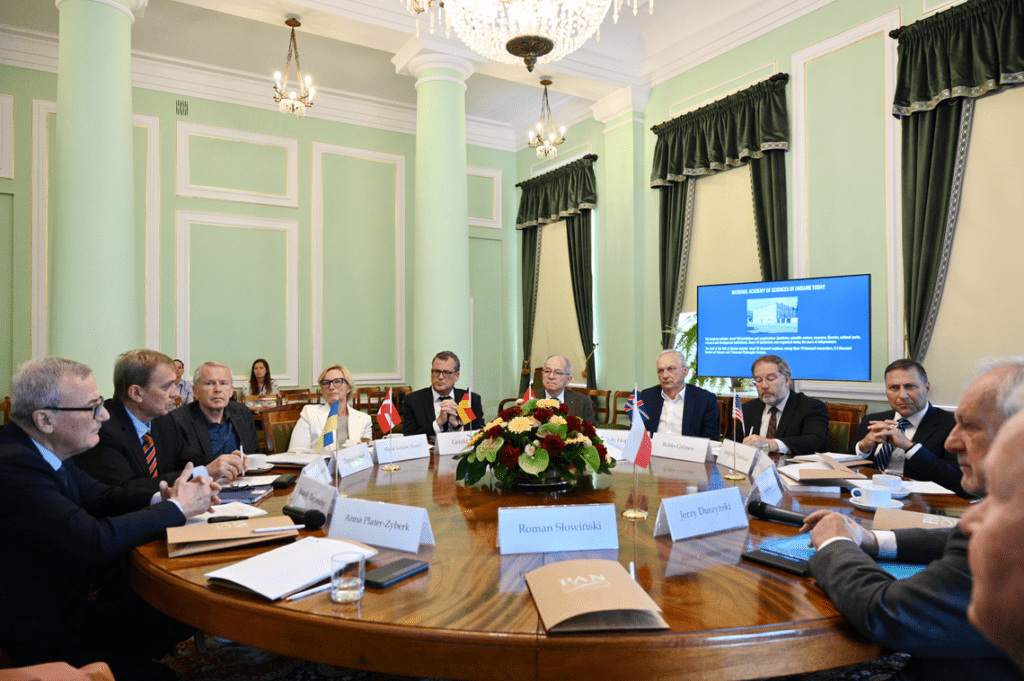
Fom the meeting in Warsaw on 2 june 2022, attended by representatives from The National Academy of Sciences USA, The Royal Society in London, The German National Academy of Sciences Leopoldina, The Polish Academy of Sciences, The National Academy of Sciences in Ukraine, All European Academies (ALLEA), and The Royal Danish Academy of Sciences and Letters.
Academies have joined forces across national boundaries to support vulnerable researchers from Ukraine. At a meeting in Warsaw on 2 June 2022 a ten-point plan of action was drawn up aimed at specifically helping young researchers. The plan has just been published in the scientific journal Science.

By Rikke Reinholdt Petersen 

Representatives from academies in various countries recently came together in Warsaw to discuss ways of helping Ukrainian researchers. Among the participants were the National Academy of Sciences USA, the Royal Society in London, the German National Academy of Sciences Leopoldina, the Polish Academy of Sciences, the National Academy of Sciences in Ukraine, All European Academies (ALLEA), and the Royal Danish Academy of Sciences and Letters. The goal was to lay the foundation for a sustainable plan to help vulnerable researchers from Ukraine both immediately and in the longer term. The plan proposed 10 areas of action and has just been published in the international scientific journal Science.

“[NA1] There is a broad consensus across the academies that we need to find means of cooperation on rebuilding a strong system for research, teaching and innovation in Ukraine. But this has to be done in a way that gives the country and its people long-term security and stability,” says Marie Louise Nosch, President of the Royal Danish Academy of Sciences and Letters.

She points out that, apart from the question of a sustainable, long-term strategy, the academies also had another focus:

”The most vulnerable are the younger researchers, most of them women, who have not established themselves in the academic environment to the same extent as their more senior colleagues. This group has to be given special attention and prioritised in our planning,” emphasises Nosch. Together with Secretary-General Thomas Sinkjær she represented the Royal Academy at the meeting in Poland.

The academies’ recommendations are based on the conclusions of the Warsaw meeting and flesh out the areas of action and strategic measures for helping researchers from Ukraine. They are primarily directed at transnational research environments. Read more about the ten points from the action plan on the website of the National Academy of Sciences USA or see full article in Science.

Find out more about initiatives to help vulnerable researchers in Ukraine.

Nobel lecture by Frank Wilczek: pictures from the occasion

Nobel lecture by Frank Wilczek: pictures from the occasion

Photo: Lars Svankjær / Royal Academy
On 30 June 2022 the Royal Academy hosted a lecture by Nobel Laureate Professor Frank Wilczek. Despite the bright, sunny weather, there was a strong turnout for Professor Wilczek’s talk on the most powerful force in the universe, namely nuclear energy. Below are pictures of the lecture and reception.

The Royal Academy appoints a new head of policy and analysis

The Royal Academy appoints a new head of policy and analysis

On May 1, Jonas Krog Lind took up the newly created position as Head of Policy and Analysis at The Royal Academy’s Secretariat. Jonas Krog Lind comes from a position as a senior consultant at DEA.

The Royal Academy is pleased to welcome Jonas Krog Lind, PhD, as he takes up the position of Head of Policy and Analysis. Jonas Krog Lind has several years of experience with research policy and analysis from, among other places, the Ministry of Higher Education and Science, DFIR and DFF.

New head of the Royal Academy Secretariat

New head of the Royal Academy Secretariat

Photo: Kontraframe [cropped]
From June 1, The Royal Academy has a new Executive Secretary: Karin Kjær Madsen comes from a position heading the secretariat of The Danish Council for Research and Innovation Policy. She brings with her more than 20 years of experience in the field of research policy from, amongst other places, the Ministry of Higher Education and Science. Karin Kjær Madsen holds a Master’s degree in Political Science from The University of Copenhagen in 1995.

– “I am looking forward to collaborating with everyone at The Royal Academy. With its members, history and traditions, The Academy is an enormous asset. I hope to contribute to bringing even more attention and visibility to The Royal Academy and its unique qualities,” says Karin Kjær Madsen.

The Royal Academy is looking forward to benefiting from Karin Kjær Madsen’s versatile expertise in the operation of the Secretariat:

– “We are relishing the prospect of Karin Kjær Madsen taking up the position as head of The Royal Academy’s Secretariat on June 1. In addition to being a skilled manager, Karin possesses a great deal of knowledge about research policy as well as a unique knowledge of the legal framework surrounding Danish universities – among other things from her previous position as head of the Secretariat of The Danish Council for Research and Innovation Policy,” says The Royal Academy President Marie Louise Nosch and Secretary-General Thomas Sinkjær.

Read more about The Royal Academy’s Secretariat here.