The Royal Academy’s 281st anniversary

281st anniversary

The Royal Academy: a long story short

Water colour by Eli Fischer Jørgensen, former member of the Royal Academy
‘To spread enlightenment’ succinctly captures the history of the Royal Academy in a single phrase. The Royal Academy began as an idea before establishing its current identity.

By Rikke Reinholdt Petersen

The idea originated with the Danish King Christian VI and an edict dated 1743 declared that the Academy was be a royal academy of science and letters. In keeping with the times, the Age of Enlightenment, the king wished the Academy to serve to spread enlightenment – to gather knowledge and share it for the benefit of king and country. Another aim was to keep pace with other European countries, where similar scientific academies had already begun to emerge.

The royal edict represented the final approval following what the Royal Academy today considers its actual founding date: 13 November 1742. At Stormgade 261 in Copenhagen, four gentlemen convened what would later be remembered as the Royal Academy’s first meeting. Councillor of Justice Hans Gram, Professor Erik Pontoppidan, Secretary of the Danish Chancellery Henrik Henrichsen (later Hielmstierne) and the owner of no. 261, Privy Councillor Johan Ludvig Holstein drew up what the king would later hone a few months later to bestow on Denmark its own academy of science and letters.

In 1776 the Royal Academy moved into its first permanent location, the Prince’s Palace, which now houses the National Museum of Denmark. Meetings were always held here, though occasionally elsewhere due to logistical considerations, e.g. at Christiansborg Palace. A core activity both then and now, the meetings provided an opportunity for researchers from a broad array of scientific fields to engage in the exchange of interdisciplinary knowledge and discussion. New members were also elected to the Royal Academy’s various academic groups. Called classes, these groups have changed over time and are now divided into the humanities class and the natural sciences class.

Long before the Royal Academy had a permanent roof over its head, the foundation of its organisational structure was laid. The king took on the role of patron and Holstein assumed overall responsibility as the Academy’s first president, with secretary Hielmstierne providing assistance. These two positions still exist but have since expanded. Today, the Academy is led by a presidium comprising nine research members: the president, the secretary general (formerly secretary), the editor, a president for each class and two representatives from each class. The proud tradition of the nation’s regent serving as patron continues to today, with HM Queen Margrethe II at the helm.

Scientific publications represent some of the Royal Academy’s initial major endeavours. As early as 1745, the groundwork was being laid for the Academy’s own publishing house, which continues to publish books. Another project that occupied the Academy in its early years was a geographic survey to map Denmark. Until the mid-eighteenth century, measurements had only been carried out sporadically but were then largely systematized under the direction of the Royal Academy. The inherently scientific and exploratory nature of the project reflected the spirit of the Age of Enlightenment and lasted until 1843.

In the 1800s the Royal Academy began a new and significant chapter in its history. An important year was 1876, which is when J.C. Jacobsen founded the Carlsberg Foundation. Based on his strong commitment to and respect for science, Jacobsen entrusted the members of Academy in a deed of gift with the task of selecting the Foundation’s executive board from among Academy’s members. Due to its affiliation with the Carlsberg Foundation, the Academy was invited to move its headquarters at the end of the nineteenth century to the Foundation’s new building at H.C. Andersen’s Boulevard 35 in the heart of Copenhagen. Both institutions continue to share the same address to this day.

The new building and the new century saw additional expansions and innovations, the Academy growing in both size and number. A crucial year was 1920, which is when the Academy welcomed its first female member, Marie Skłodowska-Curie, who, together with a handful of other top scientists, including Albert Einstein, were inducted into that Academy that same year at the behest of, e.g. the Danish physicist Niels Bohr, who would later become president of the Academy from 1939–1962.

Much has happened since the four founders met in 1742. For better or worse, both science and world history have witnessed far too much to remain unchanged, which of course also applies to the Academy. Fortunately, the curiosity and desire to understand the world, primarily through science, that our predecessors cultivated in the Age of Enlightenment endure as a cornerstone of the Academy to this day.

Heads of department at the Danish universities

Report

Department heads at the Danish universities

A cropped version of the front page illustration from the published report. Illustration: Royal Academy
The following text is a translated section of the report.
FOREWORD

The department heads at Danish universities play an essential role when it comes to strategy and development at their institutions. In the universities’ day-to-day business they act as a bridge and intermediary between the academic staff and the senior management and strategy development. This view echoes some of the opinions that emerged in a questionnaire survey of department heads at Danish universities conducted by the Royal Danish Academy of Sciences and Letters, which is the subject of this report. Does it come as a surprise?

Yes, in some ways it does, considering how many comments over the years since the amendment to the Danish University Act in 2003 have implied the assumption that the position of head of department is unattractive. This report investigates how the department heads perceive their position and management role.

The survey is one aspect of the work the Danish Royal Academy of Sciences and Letters has carried out in recent years and falls within one of the three strategic priorities for our research policy efforts in the years to come:

  1. Science and society
  2. Governace and leadership at the universities
  3. Career paths and working conditions for researchers

This report is the first independent analysis arising from the strategic priority “Management and leadership at the universities”. Our aim with this report is to shine a spotlight on what kind of management and culture we have developed at the universities following the amendments to the law in 2003. We take a close look at the classic middle management tier – the department heads – and explore their role, function and how they see their opportunities and limits. We look more generally at their academic profile and management experience, their expectations for the future, and what motivated them to seek the position at the time. This gives us a unique insight into department heads today in 2023 – as they see themselves.

We discover that there is a lack of diversity among department heads as far as recruitment from other institutions, gender and international experience are concerned. This lends weight to our assumption that Danish research is failing to make use of significant potential by not sufficiently filling managerial positions from the ranks of the many international academics who are already employed at Danish universities or hired from abroad. We see a growing need for managerial competence to support staff from diverse countries and backgrounds. A more international approach to recruitment for managerial positions is one way forward. However, the questionnaire study does not specifically address this particular aspect, which will be a focus in the Royal Academy’s further work on the issue.

The questionnaire was developed in collaboration with the Danish Council for Research and Innovation Policy, which also conducted its own questionnaire study among researchers at the universities. We are grateful to them for our successful collaboration and for the opportunity to compare the two studies in specific areas, which made the responses all the more interesting! For example, how is the outlook of the department heads reflected in the wishes and expectations of the academic staff, and how is authority exerted in the departments?

We’d like to express our heartfelt thanks to all the department heads at Danish universities who have spent time and care on answering the questionnaire. We would also like to thank the researchers and department heads who throughout the process have helped us to refine the questionnaire and to improve the relevance of the study and the report. Our discussions with you have been invaluable.

We hope that many of you will find the study together with our conclusions and recommendations interesting and beneficial. We highly recommend that departments, researcher communities and research policy stakeholders use it as a solid starting point for the important debate about how best to support the academic staff and management at Danish universities.

We would like to say a special thank you to Jonas Krog Lind, Majka Holm, Thor Blond and Karin Kjær Madsen in the Royal Academy’s Secretariat for designing the study and the report.

We hope you enjoy reading it.

Marie Louise Nosch, president

Thomas Sinkjær, secretary-general

MAIN CONCLUSIONS OF THE ANALYSIS


LINCHPIN OF THE UNIVERSITIES

Most of the department heads at the various universities view their position as prestigious and attractive and feel that they have room to maneuver when it comes to major decisions. Their position comes with a heavy workload. It emerged from discussions with current department heads that many of them see their position as influential and rewarding. Owing to the commitment and influence which the department heads describe as having, they play an essential role in solving the present and future challenges of the universities.


COOPERATION WITH ACADEMIC STAFF

While most department heads respond positively about their department’s ability and willingness to involve the academic staff, the feedback from academic staff is more critical. This suggests that there are challenges in the cooperation between department manage-ment and academic staff. This analysis looks at whether departments have found satisfactory ways to involve staff and whether the academic staff in turn feel that they are involved to a sufficient degree.


LACK OF DIVERSITY

Department heads tend to be highly similar in type. Typically, they are middle-aged, male, recruited from the department in which they currently hold a professorship, and have an academic career in Denmark under their belt. The gender and age profile reflects the recruitment base from which the university management hires department heads. The same does not apply to the international profile.


DIFFICULT CONDITIONS IN THE SOCIAL SCIENCES AND HUMANITIES

In many instances the analysis finds that the feedback from the heads of social sciences and humanities (SSH) departments is considerably more negative than the feedback from science, technology, engineering and maths (STEM) departments. This is particularly evident when it comes to how they experience the higher management and how they rate the attractiveness of their job.


INSTITUTIONAL DIFFERENCES

The analysis finds that factors such as whether a university is old or new or size of department do not seem to play any significant role in the responses from the department heads. Nonetheless, these were factors that were highlighted in the research literature and the discussions preceding the analysis as being significant for potential differences – an indication that differences between department heads mostly have to do with the individual head of department, the main fields of the department and the immediate environment.


The conclusions are presented in an arbitrary order and are not ordered by importance.

RECOMMENDATIONS


Proceeding from the conclusions in this report, the Royal Danish Academy of Sciences and Letters proposes the following recommendations.


REFORM BREAK

Establishment of a more long-term, stable framework for strategic maneuver should become a political goal for the Danish university sector. Over many years the university sector has undergone many far-reaching changes. The reform of the framework conditions for the Danish university sector, with changes constantly on the horizon and ensuing implementation phases, is taking its toll on university staff. The analysis points to a definite need among department heads and academic staff for consolidation, stability and predictability.


FORUM FOR DEPARTMENT HEADS

A forum should be set up for department heads to share knowledge and develop best practice. The forum should be cross-disciplinary and pan-university, ideally neutral, and could be facilitated by stakeholder organisations such as Universities Denmark and the Danish Association of Masters and PhDs, now known as DM. It would be particularly relevant to share collegial and international experience with regard to involvement, co-determination and recruitment of academic staff. This would require resources to be allocated at the universities for implementation of best practice.


SSH DEPARTMENTS

The higher management at universities should be attentive to the social science and humanities departments. They should help to establish the right framework conditions in these departments to ensure that there are qualified and motivated candidates to fill the departments’ managerial positions in the future. It is the responsibility of the higher management to ensure the quality and appeal of both fields.


DIVERSITY AND TALENT POOL

The university management should, as a development goal, give greater priority to diversity, management training and talent development for their department managerial staff. For this, the recruitment base must provide scope for prioritising diversity. Diversity is not merely about representation of academic staff; it also serves to improve management by ensuring a more diverse group of leaders with a broader range of skills and new approaches to tackle the tasks which the position brings. This is backed by the findings of the analysis.


SUPPORT AND RECOGNITION

The university management and others should ensure that the position of head of department has a favourable image and is presented in such a way that today’s department heads continue to be engaged and the best candidates are attracted in the future. The decision to take on managerial responsibility in the departments should continue to be meaningful, and this means that the work carried out by department heads should be given the necessary support and recognition.


ALTERING THE POST

The post of head of department should be changed from an administrative post to an academic post with a special management allowance. An academic position signals academic legitimacy and, moreover, is in line with how the position of head of department is regarded internationally.


HIRING IN TEAMS

The universities should explore the possibility of hiring teams to the position of head of department to make the appointment more attractive. This type of appointment would also allow combined posts that would give the head of department more time for both managerial tasks and research.


POSITION AFTER APPOINTMENT

The universities should ensure that all department heads are offered a position to return to. Uncertainty about their own career prospects makes career planning difficult for department heads and is also a major problem for a head of department who, for example, is seeking an extension.


The recommendations are presented in an arbitrary order and are not ordered by importance.

Read or download the full rapport from Royal Academy here:

The Royal Academy launches a three-year dissemination project called VidenSkaber

Project launch

The Royal Academy launches a three-year dissemination project called VidenSkaber

Foto: Lars Svankjær/Royal Academy [edited]
How do we know what we know? A new project is designed to create a meeting place for researchers and people to jointly delve into the major challenges of everyday life.

Everyone in Denmark is invited to join us when the Royal Academy brings together people and researchers for a series of workshops, debates and talks that will culminate in a grand finale at the National Museum of Denmark in Copenhagen.

The aim of this three-year project, called VidenSkaber (Knowledge creates) in Danish is to raise awareness of how science works. At the crux of VidenSkaber is asking the question “How do we know what we know?” to better equip people to distinguish between what is and what is not evidence-based knowledge.

“VidenSkaber will serve to provide more Danes with insight into how science works and how it can contribute to finding solutions to society’s major challenges. In a time when the world is only getting more complex and where social media inundates us with information, it is essential to gain a clear grasp of what evidence-based knowledge is. This is crucial to making informed decisions and maintaining trust in authorities, researchers and each other,” emphasises Marie Louise Nosch, president of the Royal Academy.

In 2023 VidenSkaber began delving into a topic that concerns everyone and will involve exploring what makes a good home for you, me, our neighbour and the plant, i.e. homes that are sustainable, protect our mental and physical health and that can strengthen communities large and small.

This year’s partners include Folkeuniversitetet, which provides continuing and further education, several housing associations, various local museums, the National Museum of Denmark in Copenhagen, Ræson, which is an independent, non-profit political magazine, and Videnskab.dk, a popular science news forum. These partners will ensure that activities take place throughout Denmark in the cities of Aalborg, Odense, Høje-Taastrup, Holstebro, Varde, Copenhagen, Aarhus and Herning.

The project involves various activities, including:

  • Five workshops inviting people to be active participants who share their experiences with researchers about how we should live in the future
  • Four debates inviting people to be the audience as a moderator challenges researchers across scientific disciplines
  • Four researchers sharing their knowledge as we livestream from the Festival of Ideas, Vision and Democracy, organised by Ræson
  • Publication of research articles on Videnskab.dk on this year’s topic: science journalism

The grand finale will be a festive occasion at the National Museum of Denmark in Copenhagen on 22 January 2024 to celebrate science and gather insights from the year’s many activities and participant ideas on how we should live in the future

Founded in 1742, the Royal Academy, whose aim is to create favourable conditions for basic and interdisciplinary research, is responsible for VidenSkaber, which receives funding from the Carlsberg Foundation, Novo Nordisk Foundation and the Lundbeck Foundation. VidenSkaber will last from 2023 to 2025, with each successive year highlighting a topic that affects us all.

Visit the VidenSkaber website.

Become a member of The Academy of Science Communication

Become a member of The Academy of Science Communication

Photo: Royal Academy
The Royal Academy is now accepting applications for its next Academy of Science Communication course

Since 2021 participants from across the nation have written, filmed, presented and posted their way through the first two courses offered by the Academy of Science Communication, which offers free membership to researchers from all scientific fields.

The Royal Academy is now accepting applications for its next Academy of Science Communication course, which will begin in autumn 2023 and be available as either an in-person or online course:

The Academy of Science Communication course offers not only classes but provides a network for researchers who wish to improve their communication skills and actively participate in the public debate. The aim is to increase the amount and quality of scientific dissemination in Denmark.

To be eligible to apply for a spot on the course you must be at least an assistant professor, have research experience and preferably also experience in research-based teaching or equivalent. It is also important that you have time between classes to work with the various types of communication in the course.

“Becoming an excellent communicator requires training, training and more training. That’s why we find it essential that participants produce a great deal of content along the way,” explains Peter Hyldgård, the course instructor.

Each class will feature one or more of the country’s leading experts and media professionals with expertise on the day’s topic. Participants will receive feedback from the instructor, other participants and the many users who read their articles, see their posts on Twitter or hear them give presentations.

A previous participant’s evaluation states:

“An incredibly inspiring and powerful presenter! The Academy of Science Communication has created a space where people can openly share their experiences and feel comfortable about being in a vulnerable position because you’re always met with positive and constructive feedback from the other participants. It’s amazing and highly valuable.”

After the course ends participants remain a member of the Academy of Science Communication, giving them the opportunity to continue being part of an extensive network for the dissemination of research in Denmark.

The Royal Academy runs the Academy of Science Communication, which is supported by the Carlsberg Foundation and Novo Nordisk Foundation.

New members elected to the Royal Academy

New members elected to the Royal Academy

Next month the Royal Academy will induct 10 new members in the Humanities and Social Sciences class.

Each year the Royal Academy elects new members within two areas and this year the Humanities and Social Sciences class will welcome 10 additional researchers.

Founded back in 1742 the Royal Academy endeavours to strengthen the position of science in Denmark and promote interdisciplinary understanding. This includes, for example acting as a collaborative body and meeting place for prominent researchers from all areas of basic scientific research. As a result the Royal Academy elects new members to one of the organisation’s two areas: the natural sciences, and the humanities and social sciences. In May this year the latter area will welcome new members.

In 2023, similar to recent years, there is a high degree of professional diversity among those selected. Their research areas range from architecture and language to media and economics. This professional diversity aligns well with the Royal Academy’s objective to create interdisciplinary dialogue and collaboration. There is an equal number of men and women among the ordinary members, just as research institutions throughout the country are represented.

The following individuals have been inducted into the Royal Academy:

Ordinary members:

School of Communication and Culture – Media Studies, Aarhus University

Department of Language, Culture, History and Communication, University of Southern Denmark

School of Culture and Society, Aarhus University

Department of Cross-Cultural and Regional Studies, University of Copenhagen

Department of Economics, University of Copenhagen

The Saxo Institute, University of Copenhagen

Institute for Architecture and Technology, Royal Danish Academy – Architecture, Design, Conservation

The Saxo Institute, University of Copenhagen

The Royal Academy’s ordinary members comprise Danish citizens and foreign nationals with permanent residence or permanent employment in Denmark.

Corresponding members:

Gotha Research Centre, University of Erfurt

KTH Royal Institute of Technology

The Royal Academy’s corresponding members comprise foreign nationals who do not meet the requirement of permanent residency or permanent employment in Denmark.

When new members are again elected in 2024 the natural sciences will be represented.

Read guidelines for Royal Academy selection process, or view and search the list of current members of the Royal Academy.

If you have any questions about the selection process, please contact programme consultant Trine Hagerup at th@videnskabernesselskab.dk or +45 3149 2316.

From Ph.D. to Nobel Laureate

Nobel lecture

From Ph.D. to Nobel Laureate

Photo: Royal Academy
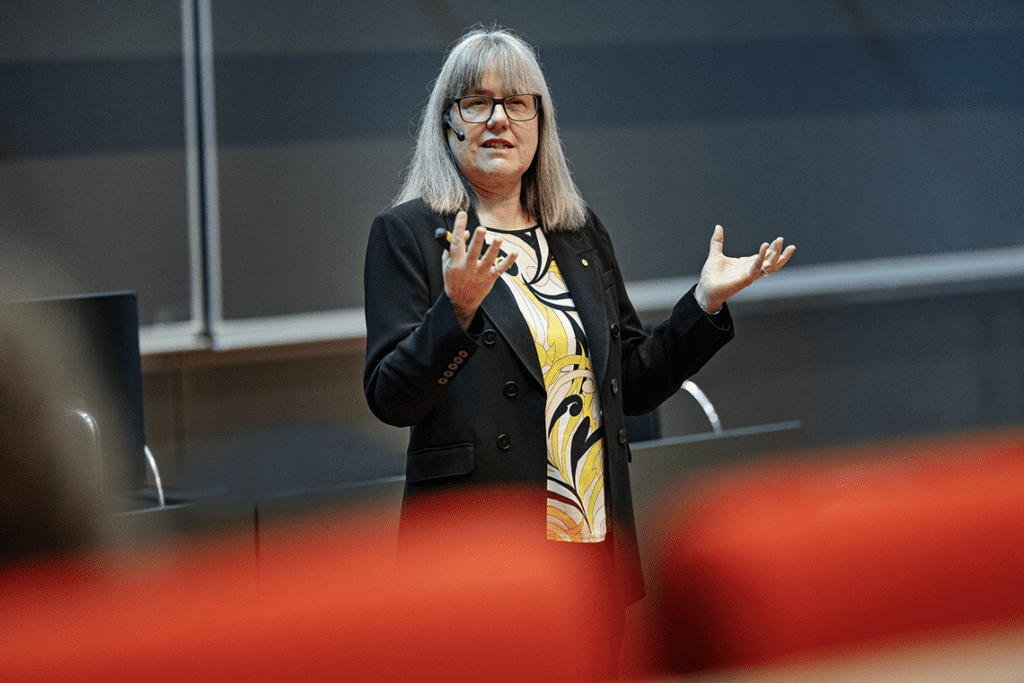
Discoveries made by PhD students rarely result in a Nobel Prize, but this is what happened to Donna Strickland, whose groundbreaking work in laser physics ushered in not only a new understanding of physics but also optimised mobile phone screens and improved people’s vision.

By Kristoffer Frøkjær

The auditorium is packed to the brim. From the back row both ponytails and balding crowns are visible in the audience. Strickland appeals to young students and the old alike, which highlights the purpose of the Royal Academy’s Nobel lectures: to give a wide audience the opportunity to hear the best scientists in the world. Strickland is unique, but not only because of her Nobel Prize:

“Even though the Royal Academy has hosted more than 21 events like this in collaboration with the Novo Nordisk Foundation since 2011, it’s the first time we welcome a woman to the stage,” says Professor Thomas Sinkjær, Secretary General of the Royal Academy, in his welcome to the Nobel Prize winner.

A splendid union of applied and basic research

On the stage a middle-aged woman is gesturing animatedly:

“In my talk I’d like to discuss both applied and basic research – so let’s start by going back 150 years in time. Back then we didn’t know whether a photon was a particle or a wave. Today we know it is both.

But getting this far required the intervention of both Einstein and Planck. And it wasn’t until as late as 1960 that we got the first laser – despite the fact that Einstein already laid the mathematical foundation back in 1917. Laser light is different from ordinary light from a light bulb, for example because it can be pointed in a specific direction. The discovery of the laser had an enormous impact and led to major breakthroughs up to the 1980s. But then a standstill occurred because the light in lasers at the time could not be made stronger without destroying the laser itself.

1.4 km instead of 2.5 km

But then Strickland and her supervisor at the time, Gérard Mourou, stepped in. At this point Strickland shows a photo of herself – a noticeably young version from 1983 – in front of the laser she worked with some 40 years ago. It consisted of a large coil of fibre optic cable.

“Light had to be transmitted throughout the 1.4 km of cable in that coil. People always ask: ‘Why exactly 1.4 km of cable? Why did you use 1.4 km of cable for the experiment that led to a Nobel Prize?’”

With her usual sense of humour, she continued:

“People think that to win a Nobel Prize, everything has to be 100% well thought out. I originally had 2.5 km but it broke. So the answer to why 1.4 km is that that’s where the cable broke. I always mention this because it’s the nature of science to find solutions to the problems you encounter in your research. And even when you do things wrong, you can still win a Nobel Prize.”

The technology she developed using the 1.4 km of cable, and all the other technical hardware, broke the boundaries of what was possible with laser technology at the time. Suddenly, it was possible to create light that was a thousand times stronger than before and to knock electrons off atoms. This opened up new opportunities for understanding the physics around us and for major basic research discoveries. But the discovery of a new type of laser light has also been used, for example in eye surgery, where ultra-short pulses have improved the vision of millions of people, and in materials science, where laser pulses can create, for instance better smartphone screens.

The future: From light to matter

To conclude her lecture, Strickland looked into the future. Historically, since the 1960s, the intensity of laser light that can be emitted has continually increased. Today it is around a quadrillion times stronger than the first lasers. And this development will continue, predicts Strickland:

“Fantastic facilities exist now in both Europe and South Korea. And the intensity of laser light will continue to grow so that one day – maybe not just around the corner, but one day – we will be able to turn light into matter. When that happens we will have completely new opportunities available for understanding the world around us,” she concludes and is greeted by loud applause from the audience.

The Royal Academy has arranged Nobel Prize lectures since 2011 in collaboration with the Novo Nordisk Foundation. This lecture was held at the University of Copenhagen.

The fabric of change

The Royal Danish Academy of Sciences and Letters

The fabric of change

Photo: Royal Academy
The networking day for Ukrainian researchers at the Royal Academy was a reminder on International Women’s Day of a community standing strong in the face of adversity.

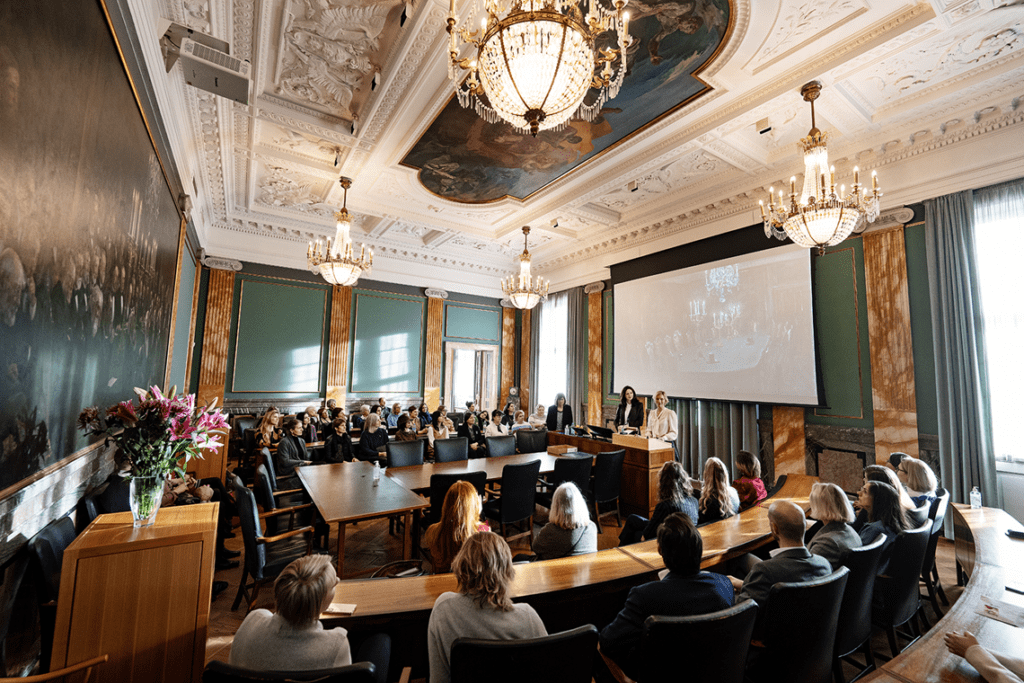
Bright sunlight promising the imminent arrival of spring streams through the high windows of the splendid meeting room, casting long rays on the marble walls and illuminating the numbers on the slide displayed on the screen.

The numbers tell the story of the war: the casualties, the hospitals that have been destroyed, the houses that have been bombed, the children who are missing, injured or killed. Standing next to Academy President Marie Louise Nosch is Kristina Vydoinyk, wife of the Ukrainian Ambassador, who is visibly moved as she reads out the terrible numbers to the audience of mainly women.

– “Over 8 million Ukrainians have left their country because of the war, most of them women and children. Some of you are in this room today”, says Vydoinyk.

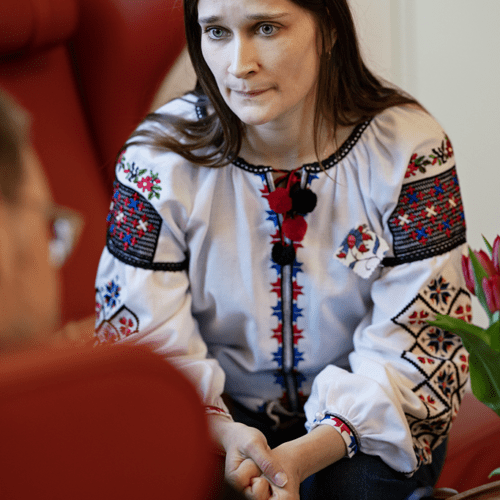
Sitting in the audience are not only women who have fled Ukraine, but also Danish academics, since many of the refugees are researchers who are currently living and working in Denmark and who have joined Danish research institutions. They have come here today on International Women’s Day to build up their network and find support.

Shared mission

The Royal Academy and Vydoinyk have a shared mission to improve conditions for the refugees.

In October 2022 the ambassador’s wife set up the Copenhagen branch of Women for Ukraine, a non-profit organisation originally established by Ukraine’s first lady Olena Selenska with the aim of uniting women internationally.

Since the start of the war, the academic community in Denmark has been closing ranks around Ukrainian refugee academics and providing support. Private funds and research institutions like the Royal Academy have joined forces to offer help, initiate mentoring networks and try to secure opportunities for Ukrainian scientists so that they can carry on their research in Denmark while the war continues.

In summer 2022 the Royal Academy, together with international partners such as ALLEA and other science academies, identified ways in which the Ukrainian research community could be helped, summarising them in 10 points. One proposal is to help create better networks for refugee researchers from Ukraine, which is the purpose of today’s event.

When the war is over

Against a backdrop of systematic destruction of laboratories and other research facilities, disruptions to the electricity, heating and water supply in many places, and a loss of learning environments, a future time of peace and thriving research environments seems a long way off. But it is important to remember the vital role of women when that time comes, says Academy President Nosch:

– “Our fellow women researchers will go back when the war is over, and I believe they will revolutionise the academic world in in their home country, returning to Ukraine with an international network, new partners and knowledge of how research is done in other places in the world. They will enrich and enhance their workplaces and will start questioning institutions and the older generation of professors, still predominantly male”.

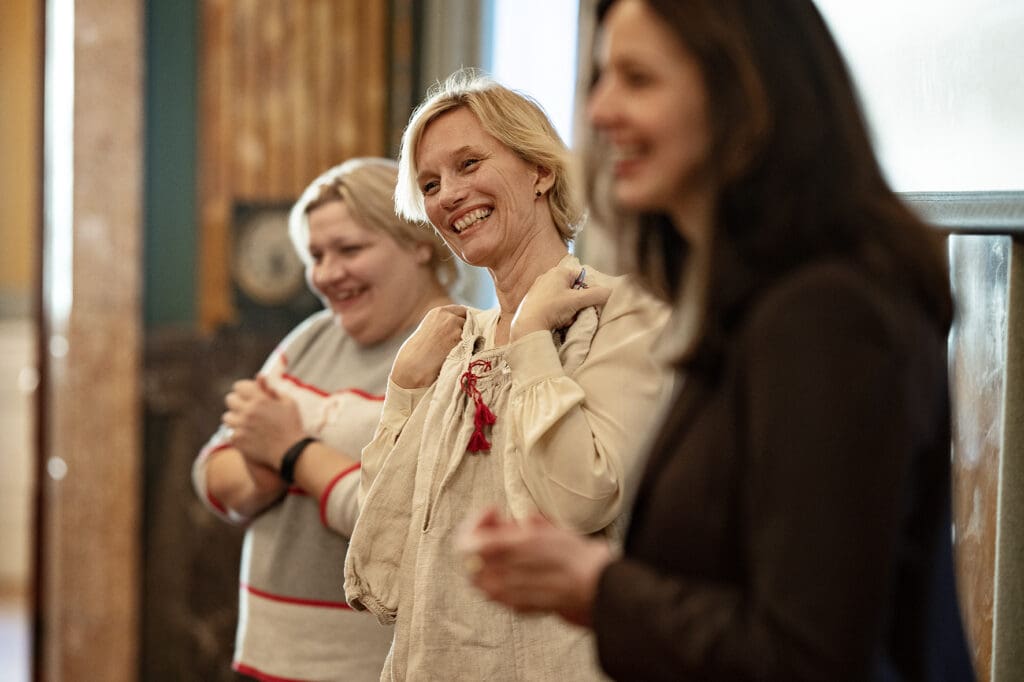
To enthusiastic applause, a Ukrainian scientist stands up and addresses the audience – Alina Korobeinyk from Aarhus Institute of Advanced Studies. She has a PhD in materials science and took part in a previous networking event at the Royal Academy in autumn 2022. On behalf of the Ukrainian researchers, she thanks the Academy President, whose research has a focus on ancient textiles.

– “We know that you specialise in textiles, which is why we would like to present you with this garment from Ukraine as a token of our appreciation for your tremendous support for Ukrainian academics in Denmark”, Korobeinyk explains.

The gift is a traditional dress that is over 70 years old.

And this was not the only reference to textiles during the day. As the participants were walking up the stairway in the entrance hall earlier on, President Nosch invited them to take a small piece of fabric from a box of differently patterned swatches.

She explained that the idea was to find the person with the matching piece of cloth in the same pattern during the coffee/tea break and to find out more about them.

But before the break, it is time for the last presentation of the day by the Rector of Roskilde University, Hanne Leth Andersen.

Roskilde University Rector provides figures and a nuanced picture

Since it is International Women’s Day, there is a hint of fighting spirit in the air, and Andersen outlines the research situation in Denmark, likening it to a leaky pipeline – the higher up the academic hierarchy, the fewer the women: almost half of all PhD graduates in Denmark are women yet only 23% of professors are female. During the course of their careers, more women than men disappear from academia, which means we are losing both resources and talent.

– “Believe it or not, I am only the third-ever female rector from a Danish university so there’s still a great deal to fight for despite things moving in the right direction”, she points out.

Here we could draw inspiration from the Ukrainian research world, where 45% of all researchers in Ukraine are women – the corresponding number in Denmark is 33%.

To a round of applause from a room buzzing with a sense of community despite the unfortunate backdrop to the meeting, the women disperse to enjoy coffee and cake, mingle and network – to find others with the same fabric, maybe others cut from the same cloth.

Carlsberg Foundation research prices 2023

Carlsberg Foundation research prices 2023

Photo: Private
Call for proposals of recipients for the Carlsberg Foundation Research Prizes 2023

On the occasion of the 200th birthday of Brewer J.C. Jacobsen in 2011, the Carlsberg Foundation established two Research Prizes – one is awarded to a scientist within the natural sciences, and one is awarded to a scientist within the humanities or social sciences. The prizes of 1 million Danish Kroner each are awarded once a year. The prize is divided between further research work (750.000,-) and a personal award (250.000,-).

The two prizes are awarded to active and recognized researchers who have contributed considerably to basic research and are widely recognized in the scientific environment.

The prizes will be presented at a ceremony at the Ny Carlsberg Glyptotek in Copenhagen on Wednesday 6 September 2023.

Criteria for forwarding proposals and the proposed candidates

  • Candidates must be active scientists of any nationality employed at a Danish research institution or Danish scientists living and working abroad.
  • Research institutions in Denmark and scholars in Denmark and abroad may propose a candidate.
  • Candidates previously proposed may be put forward again.
  • Proposing oneself will not be accepted.

Award criteria

The outstanding candidates have/must be:

  • Demonstrated outstanding impact and sustained performance in research over many years.
  • Transformed, changed, moved, or challenged disciplines.
  • Contributed to science by rethinking or changing data, theories and/or methods.
  • A role model for younger scholars.

The proposed recipients of the prizes are assessed by an international prize committee set up by the Royal Danish Academy of Sciences and Letters and the Carlsberg Foundation. Based on this assessment, the committee will select two candidates to be nominated as recipients of the Carlsberg Foundation Research Prizes.

Please complete the form below (or click link here) and attach one full PDF with 1) a motivation for the proposal (3 pages maximum) and 2) a CV, preferably including a list of publications, in the order mentioned.

All proposals must be in English and must be submitted on Tuesday 21 February, 2023 at 12.00 noon. 

For further information, please contact Programme consultant Mette Miller Danielsen on mda@royalacademy.dk.

Gala celebration of Royal jubilee and Nobel anniversary

Pictures from the celebration

Gala celebration of Royal jubilee and Nobel anniversary

On 1 October 2022 the Royal Academy held a gala event to mark the 100th anniversary of the awarding of the Nobel Prize to Niels Bohr and the Golden Jubilee of H.M. Queen Margrethe of Denmark.

By Rikke Reinholdt Petersen

– “Niels Bohr, as a recipient of the Order of the Elephant, is the closest the science community has come to the Royal Family, but the Royal Family has long been close to the science community”.

These were the opening words of Professor Marie Louise Nosch, president of the Royal Academy – and thus one of Bohr’s direct successors to the position – at the Academy’s major celebratory event of the year, which took place on 1 October 2022 in the Great Hall of Christiansborg Palace.

Much in common

In her address to H.M. The Queen, President Nosch spoke of the enduring connection between the Academy and its patron:

– “The Queen’s father, King Frederik IX, was fond of visiting the Academy; as a young crown princess, your Majesty attended Academy meetings and as a sovereign, Your Majesty has helped to keep a public focus on the Academy as a national resource by attending our celebrations and award ceremonies and authorising the establishment of Queen Margrethe II’s Science Award in 2015”.

The President expressed her deep gratitude to the Queen for her commitment and went on to highlight an important point concerning the long tradition of cooperation:

– “The Danish Royal Family, by electing to prioritise the sciences and the Royal Academy, serves to highlight the relevance of science for our society”.

According to Nosch the monarchy and the sciences share many similarities:

– “The monarchy and the sciences have common traits. Both go back many thousands of years to antiquity, the monarchy as a form of government, the sciences as a form of thinking. A monarch’s reign, like the sciences, is in for the long haul, and endurance is our strength. Although the media and the public like to focus on individual people, scientists and sovereigns understand that we are merely part of a long line of people reaching far back and on whose shoulders we stand. We apply ourselves with dedication when we have a task to fulfil but we are well aware that ultimately what matters is the contribution we have made and which will endure after we are gone”.

Paths which cross

Apparently not only the sciences and the monarchy cross paths in various ways. In his speech about Bohr former president of the Academy, Mogens Høgh Jensen, described a very special meeting at the Carlsberg Honorary Residence, pointing out how H.M. The Queen of Denmark and Professor Niels Bohr had also crossed paths:

– “The late Queen Elizabeth paid a visit to Denmark in 1957 and on that occasion visited the Honorary Residence together with the Danish royal couple and the young 17-year-old heir to the throne, Princess Margrethe was present. Tomas Bohr [Niels Bohr’s grandchild and today member of the Royal Academy] remembers how all the grandchildren at the time donned their Sunday best and stood in a line with neatly parted hair to greet the Princess”.

The anecdotes about Niels Bohr concluded with a clear message from Jensen, who, like Bohr, is a professor at Niels Bohr Institute:

– “Niels Bohr is no longer with us. But his physics, his personality and the institute are very much alive”.

Later in the evening, the speeches by Nosch and Jensen were followed by speeches by the Minister of Science and Higher Education, Jesper Petersen, and not least H.M. The Queen, who thanked the Royal Academy for its book, Monarkier, published on the occasion of the royal patron’s jubilee and presented to the royal patron by its editor, Dr. Marianne Pade, who briefly explained how the book was a product of a symposium on monarchies held in February this year and also attended by H.M. The Queen.

Prior to the speeches and presentation of the book, there was a dinner, entertainment provided by the Orchestra of the Danish Royal Guard presented by Frederik Cilius and Mathias Hammer, and a quadrille for the guests.

Morten Meldal, member of the Royal Danish Academy, receives Nobel Prize in chemistry

Nobel Prize in chemistry 2022

Morten Meldal, member of the Royal Danish Academy, receives Nobel Prize in chemistry

Ifentra dum furetortius, oca si peris, etil nomen klarum
“I was taken completely by surprise when they called me at 11 am,” a jubilant Meldal tells the Royal Academy on being awarded the Nobel Prize. He is the first Danish recipient in 25 years.

By Rikke Reinholdt Petersen

We can almost hear Meldal beaming when we talk to him on the phone after only having just learned about his award a couple of hours before:

– “I never thought I’d receive a Nobel Prize, I was completely bowled over when they rang”, Meldal tells us over the phone, bubbling with enthusiasm.

The prize, which the Nobel Committee announced is for the development of click chemistry and bioorthogonal chemistry, has been awarded jointly to Meldal, professor at the Department of Chemistry, University of Copenhagen and his American fellow researchers Barry Sharpless from Scripps Research, California, and Carolyn R. Bertozzi from Stanford University, California.

– “I did think that the bioorthogonal part of the research might win a Nobel Prize but that only Carolyn Bertozzi would receive it”, says Meldal.

However, according to the Royal Swedish Academy of Sciences, which selects the laureates, the joint endeavour of the three scientists is what earned them the prestigious award. As a Swedish press release just published today, 5 October 2022, explains:

– “The 2022 Nobel Prize in Chemistry is about making difficult processes easy. Barry Sharpless and Morten Meldal have laid the foundations for a functional form of chemistry – click chemistry – where molecular building blocks snap together quickly and efficiently. Carolyn Bertozzi has taken click chemistry to a new dimension and started utilising it in living organisms”.

Transformative

– “Receiving the Nobel Prize will have a big impact”, says Meldal humbly, adding: “I’ve spent quiet years focusing on my research and teaching at the university. This prize will have huge consequences both for the research and my work, and I think it places certain expectations on me, as well as on my department [Department of Chemistry]”.

Meldal relates how his colleagues and the students at the Department of Chemistry are already joining in the celebrations.

– “And I’m sure that the staff at the Carlsberg Research Laboratory are also delighted”, he adds.

Prior to joining the Department of Chemistry at the University of Copenhagen, Meldal carried out his research at Carlsberg Research Laboratory, where he took the first steps, together with a PhD student, towards the discovery that secured him the Nobel Prize in Chemistry today.

– “Discovering a new chemical reaction can be transformative. And that’s what this is”, concludes Meldal proudly.

Meldal, a member of the Royal Academy since 1998, will take part in a members’ meeting in late November, where he will give an introductory presentation on his prize-winning research.

The Nobel Prize in Chemistry is awarded by the Royal Swedish Academy of Sciences and carries a monetary award of SKK 10 million to be shared by the winners.

The prize winners

Morten Meldal, born in Denmark in 1954, was awarded his PhD in 1986 from the Technical University of Denmark, Lyngby. Professor at the Department of Chemistry, University of Copenhagen, Copenhagen, Denmark. Member of the Royal Danish Academy of Sciences and Letters since 1998.

Carolyn R. Bertozzi, born in the United States in 1966, earned her PhD in 1993 from University of California, Berkeley, USA. Anne T. and Robert M. Bass Professor at Stanford University, California, USA.

Barry Sharpless, born in the United States in 1941, received his PhD in 1968 from Stanford University, California, USA. W. M. Keck Professor at Scripps Research, La Jolla, California, USA.