CALL FOR PARTICIPANTS: Join the Academy of Science Communication 26/27
Join the Academy of Science Communication 26/27 – English programme
The Communication Academy is simultaneously a training programme, a public engagement initiative, and a network for researchers who want to improve their communication skills and take a significant, active step into the public spotlight with their academic expertise in hand. The aim is to create more—and better—science communication in Denmark
About the Communication Academy
The Communication Academy aims to create a community with a constant focus on fostering new, meaningful connections between research and society. For this reason, you will remain a member of the Communication Academy even after the course programme ends—and we expect that, as a member, you will participate in the Academy’s activities in the years to come.
The Communication Academy is built around a range of course programmes, where participants can choose between a short online course or a longer, intensive programme with in-person attendance.
The course director is science journalist and communication trainer Peter Hyldgård. At each course session, one or more of the country’s leading experts and media professionals will also contribute, bringing specialist knowledge related to the topic at hand.
Here you can apply for admission to the longer, intensive programme in English with in-person attendance (November 2026 – May 2027).
Course content
During the course, you will meet some of Denmark’s most skilled journalists and communication professionals, who will teach and provide individual feedback on everything from public talks to social media posts.
Over the span of seven full course days, supplemented by short online sessions, you and the other participants will work with various formats such as articles, videos, presentations, social media, and media relations.
You will also develop a strategy for how science communication can fit into a busy scientific research career. Between sessions, you’ll complete practical exercises with personalized feedback.
In addition to the scheduled sessions, you will work on communication tasks between course dates – such as writing a popular science article, giving a public talk, filming a video, and maintaining an active presence on social media.
It is therefore important that you can set aside time both to attend all sessions and to complete the tasks during the programme – including providing feedback to your fellow participants on their work.
We estimate the total time commitment for each participant at approximately 20 working days over the seven-month period.
Teaching staff
Digital public affairs adviser Benjamin Rud Elberth; science communication coach and consultant Peter Hyldgård; actor Nastja Arcel; Holly Squire; editors from Videnskab.dk; and others.
Time and placeModules run during winter and spring 2026–2027. Teaching is organised as a hybrid of in-person and online sessions. Dates are as follows:
In-person sessions:
- Tuesday 8 December 2026, 10:15–17:00
- Wednesday 9 December 2026, 09:00–16:00
- Tuesday 2 February 2027, 10:15–17:00
- Wednesday 3 February 2027, 09:00–16:00
- Tuesday 13 April 2027, 10:15–17:00
- Wednesday 14 April 2027, 09:00–16:00
- Week 17: Talks and outreach activities during the sci-com festival Forskningens Døgn
- Tuesday 25 May 2027, 10:15–20:00
Online sessions:
- Tuesday 17 November 2026, 16:00–18:00
- Tuesday 19 January 2027, 16:00–18:00
- Tuesday 9 March 2027, 16:00–18:00
- Tuesday 4 May 2027, 16:00–18:00
In-person course days will, as a rule, take place at the Royal Danish Academy of Sciences and Letters in Copenhagen, with a small number of off-site visits.
You must be able to take part in the “Book a Researcher” initiative during the national Festival of Research (Forskningens Døgn), held in Week 17 of 2027 (26-30 April).
Admission criteria and expectations
The Academy of Science Communication is free of charge and open to researchers from all scientific disciplines. This particular programme is aimed at researchers in Denmark who do not speak Danish as their first language, but who wish to communicate with the Danish public.
The teaching will therefore be conducted in English, and the programme aims to equip you to communicate in either English or Danish with Danish media and platforms.
All applicants must meet the following criteria:
- You hold a position at Assistant Professor level or above (or equivalent) and have a solid research profile.
- Experience with research-based teaching or similar is an advantage.
- You are passionate about science and envision a future within the research community.
- You may be employed at a university, a private research company, or a communication institution such as a museum. Membership of the Royal Danish Academy of Sciences and Letters is not required.
- You have gained some initial, first-hand experience with science communication.
- You are motivated to engage in dialogue with the public.
In addition, we expect you to participate actively in all aspects of the Academy — not only on course days, but also through preparation and concrete communication activities throughout the programme.
You should only apply if you are genuinely committed and able to invest both your time and energy in the project. We also expect that, as an alumnus, you will continue to engage in the Academy’s activities in the years to come and act as an ambassador for science communication within your research environment.
In return, we offer what is likely the most comprehensive training in scientific research communication in Denmark, along with access to a unique network of skilled science communicators.
Note: It is possible to apply as a postdoc if you have a particularly strong scientific research profile and extensive experience, and if you are likely to contribute actively to science communication in Denmark through a future scientific research position. This option is most relevant in fields where permanent positions such as Assistant Professor or tenure-track roles are relatively difficult to obtain. All else being equal, and within the same discipline, researchers in permanent positions will be prioritized over postdocs.
Contact
For questions regarding the course, please contact:
• Course Coordinator Johanne Holm at jh@kdvs.dk or by phone at +45 31 55 52 02
• Course Director Peter Hyldgård at ph@kdvs.dk or by phone at +45 20 87 77 56.
You are also welcome to reach out if you or your institution are interested in collaborating with the Academy of Science Communication on developing science communication and training initiatives at a department, faculty, or similar setting.
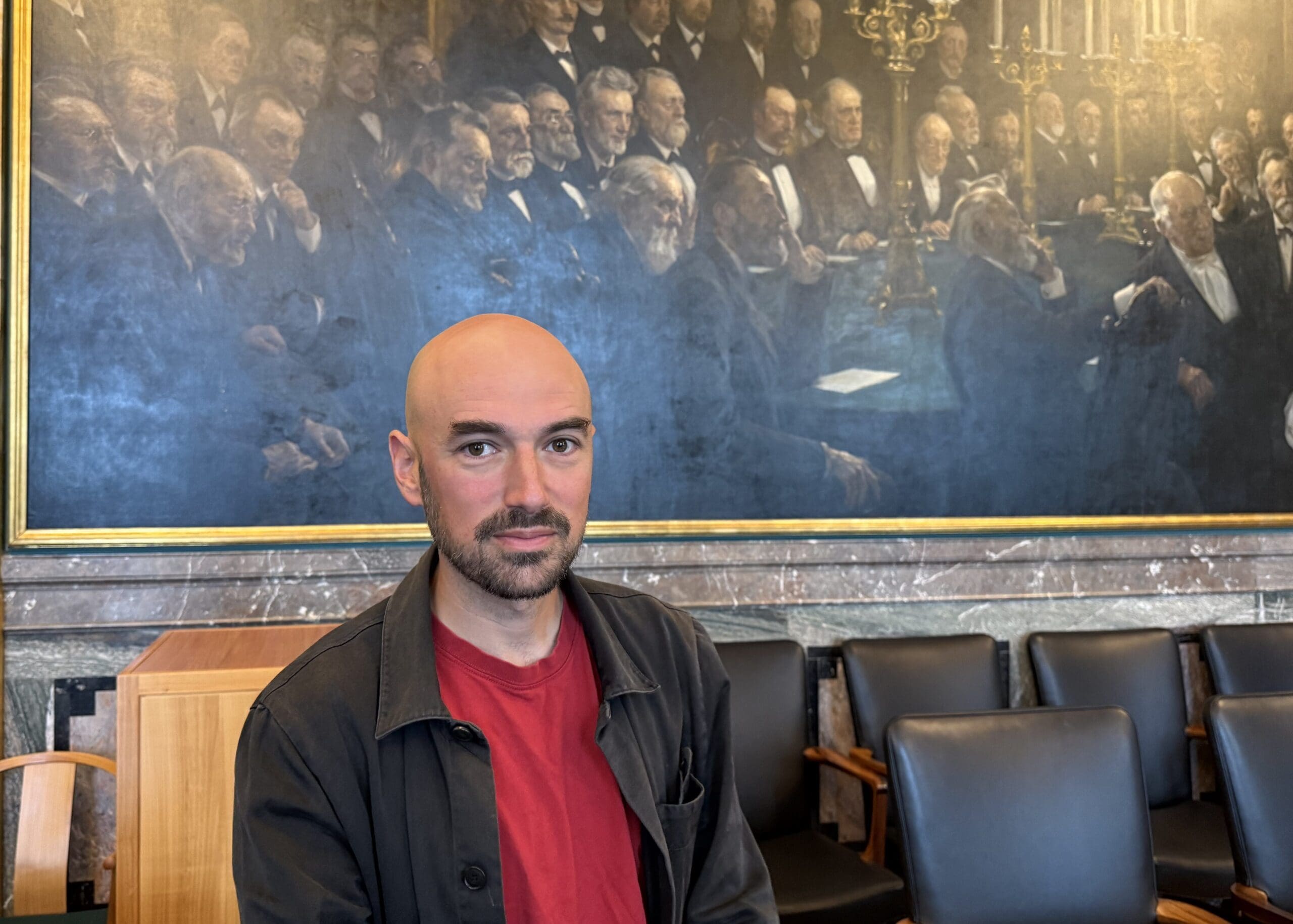
Foto: Kristoffer Szilas, Curator and Associate Professor of Petrology, University of Copenhagen. Joined the Academy of Science Communication i 2021-2022.
How to apply
Your application must include:
- A motivated application letter (one A4 page) that addresses the purpose of the Academy and the admission criteria (PDF)
- A short video (max. 3 minutes) in which you explain how — drawing on your field — you can contribute to improving public debate or science communication more broadly.
- Attachments: CV including any international stays and grants (max. one page) + publication list (combined in a single PDF).
Applications will be assessed by a committee under the Royal Danish Academy of Sciences and Letters. We aim to assemble a diverse cohort across disciplines, geography, age, and gender.
You will receive a decision on your application by the end of August.
Application deadline: 14 th of June 2026